By Nicola Franklin
Where is the web going? That was the question the speakers at the 2nd November 2011 NetIKX seminar were aiming to answer. This join event, run with the Information for Energy Group (IFEG) and hosted at The Energy Institute, addressed the issue of linked data and the semantic web.
Whereas Web 1.0 might be thought of as ‘brochure ware’, one-way communication, and Web 2.0 has come to mean interactive, two-way communication online, the future seems to be for information and knowledge management itself to move onto the web.
The two speakers at this session described how this phenomenon is coming about, from two perspectives – Richard Wallis of Talis from the point of view of a producer or publisher of linked data onto the web, and Dr Victoria Uren of Aston University from the perspective of a researcher searching the semantic web.
What is linked data? Richard gave an excellent introduction to the topic, leading us through a logical path to understanding how information from different data sets can be shared, merged and used online. When the web originated, it was about publishing text documents with links to other text documents, using html. Linked data is about linking ‘things’ to other ‘things’, by giving them a label or identifier (a URI). Things also have attributes, like a name, size, location, etc.
The example Richard used was a spacecraft.
A spacecraft is a ‘thing’ and can be given a label, such as:
1969-059A.
To make sure this is a unique label, some more information might be added, for example:
spacecraft/1969-059A.
To make sure people know it is your spacecraft you might add some extra information:
nasa.dataincubator.org/spacecraft/1969-059A
To store (publish) some information about this object on the internet you just at http://
http://nasa.dataincubator.org/spacecraft/1969-059A
When people start thinking about things, their attributes and how they link up together, they tend to think visually:
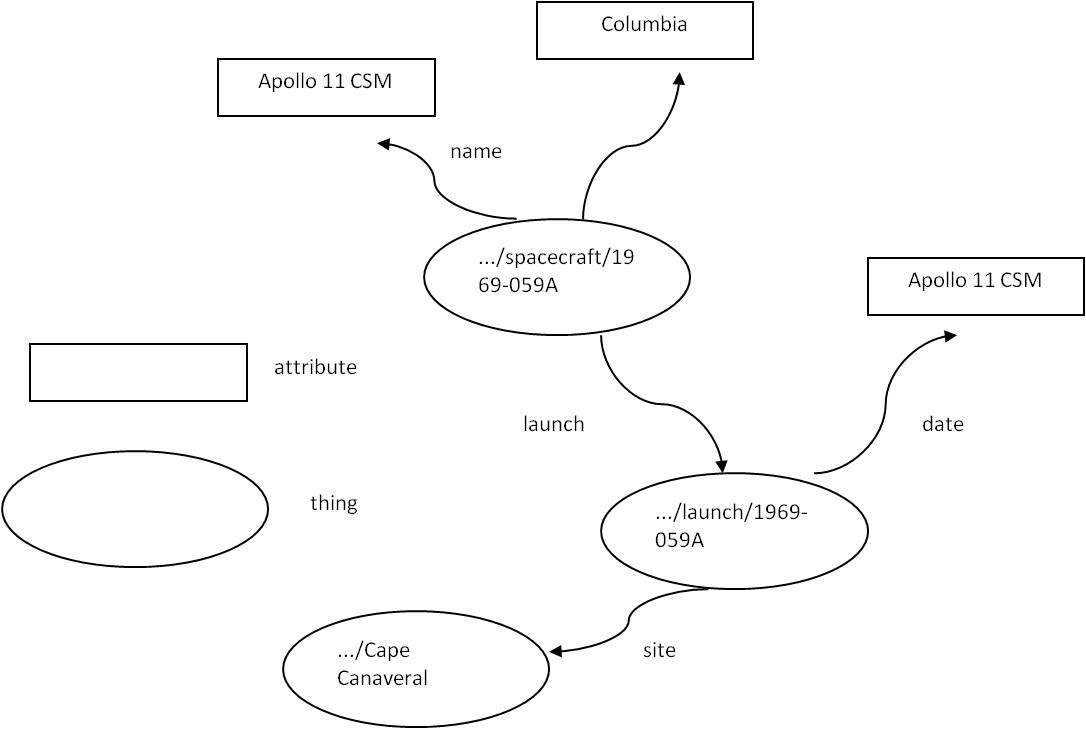
To transfer this into machine readable ‘computer speak’ the ovals are replaced by brackets:
<…/spacecraft/1969-059A> = a thing
name Apollo 11 CSM = an attribute and the value for that attribute
This language is called Resource Description Framework, or RDF for short.
Once common objects, or ‘things’, which are being talked about by different people, in different locations, are identified by the same RDF label, then attributes or data about those things can be merged from those different sources – the data can be linked.
This can be very powerful. For example, location data drawn from the Ordnance Survey can be linked with local authority data or central government data or NHS data. This could answer questions like “how much was spent by this organisation in that area on this service, when this party was in power?”.
An example of linked data in action can be found on the BBC nature website. This links together video archives from the BBC, information from Wikipedia, and information from other species or habitat-specific websites from various other organisations, displaying them all on one page.
Linked data can be used within an organisation, to publish data behind a firewall using intranet tools, which links together information from different business units, or held in different (perhaps incompatible) IT systems. It can also be used to publish data externally to the internet, where other people and organisations can link it to their own data – either by using the same identifiers for ’things’ in common, or by mapping between their identifier and another one used for the same ‘thing’.
Some common standards are emerging, where ontologies or naming schemas are being published and adopted to ensure that different organisations use the same identifying labels to refer to the same ‘things’. One example can be found at Schema.org, which is the standard being jointly adopted by Google, Bing and Yahoo.
How about semantic search? Victoria’s talk began from the opposite end of the spectrum – given that linked data exists on the web, how do you search for it?
Traditional online searching is based around keyword search, which uses methods such as counting words, page ranking using links, controlled form searching (eg; OPAC) or metadata. These methods were developed for searching text. To search structured data needs a different approach.
Victoria listed a range of query languages that have been developed but said that SPARQL, which was based upon SQL, was the most widely utilised. As it isn’t reasonable to expect users to familiarise themselves with a query language like this in order to carry out a search, a more friendly user interface is needed.
Again a range of methods have been developed:
- Keywords
- Forms
- Graph based
- Question answering
- Tabular browsing
Victoria described the pros and cons of each method:
Keyword searching is easy to use but is restricted to simple searches for ‘a thing’. Forms are a familiar interface, and allow more complex searches than single keywords, but forms need to be predefined and are therefore restrictive. Graph based searches give a visual representation of the data, but this is hard to do for anything more than one ontology (ie, data from one source). Natural language question answering is easy for the user, and good for heterogeneous data sets, but requires some heavy duty computing power to avoid being very slow. Tabular browsing, where you start with one keyword and are presented with a whole range of linked words to chose from to narrow the search, can be clumsy.
Victoria felt that semantic search is very good for corporate data management, where information is typically focused around one topic area and it is very useful to be able to bridge between different data silos. She gave examples of Drupal7, Virtuoso and Talis as systems that can be used for this.
Following a coffee break Syndicate Groups were set up to discuss several questions:
- What is the value to a business of using linked data and semantic search?
- Who would use the stuff from our organisation?
- What are our needs for corporate data management – what tools are needed?
I took part in one of the two tables discussing the first question. We felt that linking silos of information could help more people to find the right information, more quickly, and also to discover information they previously didn’t know existed (and therefore wouldn’t search for). This could lead to finding the people behind the information and strengthening relationships. It could also increase efficiency, raise cross-fertilisation and improve innovation.
During the group feedback session and discussion that followed, the issue of the risks of open and linked data was brought up. Could increased ease of access to some data, and the linking together of many pieces of data from different sources into one location, be misued? One example given was of insurance companies, potentially refusing to insure someone for a life or healthcare policy who they’d discovered had an unhealthy lifestyle. Another example could be terrorists making use of combined information from Ordnance Survey data + google maps + other data sets to plan atrocities.
Linked data tools and open data publishing seems to have many potential benefits and also some risks; as with any rapid change the regulation and safeguards against the risks will probably lag behind what is taking place in practice.

Social media – what next and what can we do with it?
/in Harnessing the web for information and knowledge exchange, Netikx/by NetikxBy Elisabeth Goodman1
NetIKX’s first seminar of 2012 was its 3rd on the theme of social media in so many years. Previous seminars have explored whether social media should be taken seriously, and how social media could be used to achieve organisational goals and the implications for organisational IM / KM policies and strategies.
This seminar took a broad look at emerging trends and products, their likely implications, and how social media are being, or could be used.
Our first speaker was Steve Dale, “a passionate community and collaboration ecologist, creating off-line and on-line environments that foster conversations and engagement”.
Our second speaker, Geoffrey Mccaleb describes himself as a social media / mobile consultant.
This blog reviews some of the common themes arising from their presentations, points discussed in syndicate or break-out groups, and in the concluding Q&A, and some of the author’s own reflections.
Social media have been evolving into so much more than plain communication tools
Both speakers shared statistics on Facebook, Twitter, LinkedIn, Google Plus, YouTube and other social media usage. The conclusion: the use of social media tools is enormous and growing! But how these tools are being used, or what they are being used for is also evolving. Here are some examples.
1. Facts and figures on some of the better known uses of social media
Employment
89% of companies used social media for recruiting in 2011. One in three rejected candidates based on something they saw online. 45% of companies surveyed used Twitter to find candidates, and 80% used LinkedIn.
Politics
This is perhaps one of the most publicised uses for social media. However, although in 2011 saw 230K tweets per day about change in Egypt the CIA were blamed for ‘missing’ Egypt protests by not monitoring Twitter. Similarly, whilst SOPA protests were being organised online, all but one of the traditional networks in the USA failed to cover them.
Reputation management
Social media is a vital medium for managing an organisation’s reputation, and yet the average time between something going viral and an official response is 48 hours. There are some exceptions for example Southwest Airlines who actively monitor and rapidly respond to anything posted on Twitter about them with a resultant positive impact on their reputation. To what extent are our organisations doing this?
Publicity / PR
47% of journalists used Twitter as a source in 2011 (up from 33% in 2010). Market-specific blogs are proving to be more popular sources of news than traditional media.
Customer support
It’s all about rethinking how companies / organisations engage with their community: social media should be a “company-wide engagement model”.
2. A broader exploration of how social media are evolving
Sharing information on interests and hobbies
Facebook lends itself well to doing this already, and is always adding new features to take this further. It’s new timeline tool being one potential example. There are other tools, such as ‘Pinterest’ that take sharing of this kind of information to another level.
Curation of information from multiple sources
Scoop.it, paper.li, Storify, Flipboard are all examples of how ‘social curators’ can bring together content from several different sources that may be of interest to their audiences. Although we did not discuss this at length, this might be a tool that Library and Information professionals could use to help their end-users with information overload?
Collaborative consumption
Some tools enable people to manage the sharing of physical resources. Examples of this are ‘Boris’s’ bikes (the London shared bicycle scheme), sharing the use of an otherwise under-used private car, ‘airbnb’ to rent out ones house / bedrooms to visitors e.g. to the Olympics. Might this be an alternative model for managing information resources between organisations?!
‘Managing’ big data
This is a pet subject of Steve’s, with data sets on the cloud becoming so large that they can no longer be managed with standard database management tools. The data are usually on the cloud and include photos, traffic data, and medical data. Visualisation and infographics tools are one way to represent and analyse these large volumes of data.
Game-ification
This is an interesting exploration of how the ‘game’ attributes of user engagement, loyalty to brands, and rewards might be transferred to a professional social network environment. In a previous seminar we heard how The Open University Library Services were already experimenting with using virtual reality tools as a support for their services. Game-ification may take this further?
Augmented reality
There are applications for golf that will let you know where the nearest bunker is and the direction of the wind. Pointing your phone at the sky can give you information about the constellations. Augmented reality applications literally augment the information that you perceive and thereby help you to look at your world in a different way.
Location-based services
Tools such as Foursquare enable you to find out what’s near you, check-in, see who else is there, become ‘mayor’ of your local pub(!) etc. ‘Easypark’ – is a Danish company which enables you to pay your parking fee and have a count-down to let you know how much time you have left to park. There is potential for these tools to be so much more than a status update, because they tell others that you like something / somewhere.
3. Some final reflections on technology trends and implications
Mobile platforms
Technology cycles are usually 10 years long, and we are now 2 years into mobile technology. Anticipation is that mobile technology will overtake desktop technology within 5 years. And some surprising statistics:
Apps
2005 – 2010 was about design for the PC with consideration for mobile platforms; 2011 – 2012 (and beyond?) will be about design for mobile platforms with consideration for PCs.
The social graph
This represents all the people that we interact with online: who we know and who we respect online. 37% of US social media users trust what their friends say about a brand or product on social media. 60% will buy something on the basis of what their connections recommend. Facebook (with shares / likes) and Twitter (with retweets) work on this basis, Google Plus is Google’s attempt at recreating the same thing.
What do people want?
To access their data everywhere – aka what is your cloud strategy?
To see things relevant to us – aka what is your social graph strategy?
To have the same experience regardless of our device – aka what is our mobile platform strategy?
4. Implications of what we heard
We explored several themes in our break out discussions and in the Q&A that followed.
What is the role of information intermediaries in the context of social media?
Are we being pushed out of our roles by these tools – or does our ‘cyberlibrarian’ or ‘curator’ role become even more important?
What is the associated information risk?
With a lot of personal information going on the internet / in the cloud, is there more scope for criminal activity and identify theft? There was concern that young people don’t appreciate the privacy issues. That they are not receiving the education they need about this. That tools such as Foursquare are invitations to burglars whilst we are not at home.
How to decide what tools to use and when?
The key is being clear about who we are trying to target and what tool(s) they would use. We discussed the difficulty of changing mindsets within organisations where there are ingrained fears about the use of social media… and how using related case studies, collecting examples of what people have been saying about the organisation, or event taking unilateral action and showing the results (!) may be the way to do this.
Participants mentioned:
How / why could people use social media tools within their organisations
Chatter, Yammer are Twitter like tools being used within organisations, and in some cases have a dramatic effect on lowering the use of e-mail. Chatter and Yammer threads are saved and searchable: and work well for organisations where people are working in different time zones. We didn’t discuss this here, but such tools could be excellent for idea generation and problem solving, or ‘crowd-sourcing’ within an organisation.
Note
1. Elisabeth Goodman is Programme Events Manager for NetIKX. She also runs her own business, RiverRhee Consulting.
January 2012 Seminar: Social Media – what next and what can we do with it?
/in Events 2012, K and I sharing: social media, Knowledge and information sharing, Previous Events/by NetikxSummary
This was out third meeting on the theme of social media in so many years. The speakers identified that the key to effective use of social media is to be clear about who we are trying to target and what tool or tools they would use. They discussed the difficulty of changing mindsets within organisations where there are ingrained fears about the use of social media… and how using related case studies, collecting examples of what people have been saying about the organisation, or event taking unilateral action and showing the results can be the way to do this.
Speakers
Steve Dale is the founder and Director of Collabor8now Ltd, an organisation focussed on developing collaborative environments (e.g. Communities of Practice) and the integration of knowledge management tools and processes to support business improvement. He is a KMI certified knowledge manager and the author of several published research papers on collaborative behaviours. Over a 30-year career he has led major change programmes and developed knowledge and learning strategies for clients across public, private and not-for-profit organisations. He is one of three community facilitators for Warwick Business School’s “Knowledge & Innovation Network (KIN)”, a not for profit member organisation committed to developing and sharing best practice. He is known as “a passionate community and collaboration ecologist, creating off-line and on-line environments that foster conversations and engagement”
Geoffrey McCaleb is a social media / mobile consultant who has delivered a wide variety of critical product capabilities for this rapidly growing video distribution startup. He specifically delivered the mobile (iOS and Android) and responsive web app experience that supported the live sports subscriptions/payments service (streaming and video on demand) for Australian Rules Football, Bundesliga, and La Liga. The service saw strong adoption growing 75% Month on Month and was a crucial component that supported their successful Initial Public Offering.
Time and Venue
January 2012. 2pm The British Dental Association, 64 Wimpole Street, London W1G 8YS
Slides
No slides available
Tweets
#netikx61
Blog
See our blog report: Social media – what next and what can we do with it?
Study Suggestions
Participants mentioned:
The BBC’s ‘YourPaintings’ joint initiative with The Public Catalogue Foundation and museums and public institutions throughout the UK encourages people to ‘tag’ their favourite oil paintings. It currently has 104,000 pictures in the collection.
Phil Bradley’s presentation and notes: “25 barriers to using web 2.0 technologies and how to overcome them” might also provide good insights.
November 2011 Seminar: What next for the web? – a look at linked data and semantic search
/in Events 2011, Harnessing the web for information and knowledge exchange, Organisation and modelling:linked data, Previous Events/by NetikxSummary
This was a joint event, run with the Information for Energy Group (IFEG) and hosted at The Energy Institute. The session addressed the issue of linked data and the semantic web.
Whereas Web 1.0 might be thought of as ‘brochure ware’, one-way communication, and Web 2.0 has come to mean interactive, two-way communication online, the future seems to be for information and knowledge management itself to move onto the web.
What is linked data? Richard gave an excellent introduction to the topic, leading us through a logical path to understanding how information from different data sets can be shared, merged and used online. When the web originated, it was about publishing text documents with links to other text documents, using html. Linked data is about linking ‘things’ to other ‘things’, by giving them a label or identifier (a URI). Things also have attributes, like a name, size, location, etc.
How about semantic search? Victoria’s talk began from the opposite end of the spectrum – given that linked data exists on the web, how do you search for it? Traditional online searching is based around keyword search, which uses methods such as counting words, page ranking using links, controlled form searching (eg; OPAC) or metadata. These methods were developed for searching text. To search structured data needs a different approach.
Linked data tools and open data publishing seems to have many potential benefits and also some risks; as with any rapid change the regulation and safeguards against the risks will probably lag behind what is taking place in practice.
Speakers
Richard Wallis is a Technology Evangelist and has been with the UK’s leading Linked Data and Semantic Web technology company, Talis, for over eleven years. This coupled with his passion for and engagement with new and emerging technology trends, gives him a unique perspective of the issues challenging Information professionals today. As Technology Evangelist he is at the forefront in promoting, explaining, and applying new and emerging Web and Semantic Web technologies in the wider information domain. Richard is an active blogger and regular podcaster in the ‘Talking with Talis’ series.
Victoria Uren supported Richard.
Time and Venue
November 2011, 2pm The British Dental Association, 64 Wimpole Street, London W1G 8YS
Slides
No slides available
Tweets
#netikx50
Blog
See our blog report: What next for the Web and information services? Linked data and semantic search
Study Suggestions
None
What next for the Web and information services? Linked data and semantic search
/in Developing and exploiting information and knowledge, Harnessing the web for information and knowledge exchange, Netikx/by NetikxBy Nicola Franklin
Where is the web going? That was the question the speakers at the 2nd November 2011 NetIKX seminar were aiming to answer. This join event, run with the Information for Energy Group (IFEG) and hosted at The Energy Institute, addressed the issue of linked data and the semantic web.
Whereas Web 1.0 might be thought of as ‘brochure ware’, one-way communication, and Web 2.0 has come to mean interactive, two-way communication online, the future seems to be for information and knowledge management itself to move onto the web.
The two speakers at this session described how this phenomenon is coming about, from two perspectives – Richard Wallis of Talis from the point of view of a producer or publisher of linked data onto the web, and Dr Victoria Uren of Aston University from the perspective of a researcher searching the semantic web.
What is linked data? Richard gave an excellent introduction to the topic, leading us through a logical path to understanding how information from different data sets can be shared, merged and used online. When the web originated, it was about publishing text documents with links to other text documents, using html. Linked data is about linking ‘things’ to other ‘things’, by giving them a label or identifier (a URI). Things also have attributes, like a name, size, location, etc.
The example Richard used was a spacecraft.
A spacecraft is a ‘thing’ and can be given a label, such as:
1969-059A.
To make sure this is a unique label, some more information might be added, for example:
spacecraft/1969-059A.
To make sure people know it is your spacecraft you might add some extra information:
nasa.dataincubator.org/spacecraft/1969-059A
To store (publish) some information about this object on the internet you just at http://
http://nasa.dataincubator.org/spacecraft/1969-059A
When people start thinking about things, their attributes and how they link up together, they tend to think visually:
To transfer this into machine readable ‘computer speak’ the ovals are replaced by brackets:
<…/spacecraft/1969-059A> = a thing
name Apollo 11 CSM = an attribute and the value for that attribute
This language is called Resource Description Framework, or RDF for short.
Once common objects, or ‘things’, which are being talked about by different people, in different locations, are identified by the same RDF label, then attributes or data about those things can be merged from those different sources – the data can be linked.
This can be very powerful. For example, location data drawn from the Ordnance Survey can be linked with local authority data or central government data or NHS data. This could answer questions like “how much was spent by this organisation in that area on this service, when this party was in power?”.
An example of linked data in action can be found on the BBC nature website. This links together video archives from the BBC, information from Wikipedia, and information from other species or habitat-specific websites from various other organisations, displaying them all on one page.
Linked data can be used within an organisation, to publish data behind a firewall using intranet tools, which links together information from different business units, or held in different (perhaps incompatible) IT systems. It can also be used to publish data externally to the internet, where other people and organisations can link it to their own data – either by using the same identifiers for ’things’ in common, or by mapping between their identifier and another one used for the same ‘thing’.
Some common standards are emerging, where ontologies or naming schemas are being published and adopted to ensure that different organisations use the same identifying labels to refer to the same ‘things’. One example can be found at Schema.org, which is the standard being jointly adopted by Google, Bing and Yahoo.
How about semantic search? Victoria’s talk began from the opposite end of the spectrum – given that linked data exists on the web, how do you search for it?
Traditional online searching is based around keyword search, which uses methods such as counting words, page ranking using links, controlled form searching (eg; OPAC) or metadata. These methods were developed for searching text. To search structured data needs a different approach.
Victoria listed a range of query languages that have been developed but said that SPARQL, which was based upon SQL, was the most widely utilised. As it isn’t reasonable to expect users to familiarise themselves with a query language like this in order to carry out a search, a more friendly user interface is needed.
Again a range of methods have been developed:
Victoria described the pros and cons of each method:
Keyword searching is easy to use but is restricted to simple searches for ‘a thing’. Forms are a familiar interface, and allow more complex searches than single keywords, but forms need to be predefined and are therefore restrictive. Graph based searches give a visual representation of the data, but this is hard to do for anything more than one ontology (ie, data from one source). Natural language question answering is easy for the user, and good for heterogeneous data sets, but requires some heavy duty computing power to avoid being very slow. Tabular browsing, where you start with one keyword and are presented with a whole range of linked words to chose from to narrow the search, can be clumsy.
Victoria felt that semantic search is very good for corporate data management, where information is typically focused around one topic area and it is very useful to be able to bridge between different data silos. She gave examples of Drupal7, Virtuoso and Talis as systems that can be used for this.
Following a coffee break Syndicate Groups were set up to discuss several questions:
I took part in one of the two tables discussing the first question. We felt that linking silos of information could help more people to find the right information, more quickly, and also to discover information they previously didn’t know existed (and therefore wouldn’t search for). This could lead to finding the people behind the information and strengthening relationships. It could also increase efficiency, raise cross-fertilisation and improve innovation.
During the group feedback session and discussion that followed, the issue of the risks of open and linked data was brought up. Could increased ease of access to some data, and the linking together of many pieces of data from different sources into one location, be misued? One example given was of insurance companies, potentially refusing to insure someone for a life or healthcare policy who they’d discovered had an unhealthy lifestyle. Another example could be terrorists making use of combined information from Ordnance Survey data + google maps + other data sets to plan atrocities.
Linked data tools and open data publishing seems to have many potential benefits and also some risks; as with any rapid change the regulation and safeguards against the risks will probably lag behind what is taking place in practice.
September 2011 Seminar: Developing our capability – A practical tool-kit for IM/KM practitioners and their customers
/in Developing and exploiting information and knowledge, Events 2011, Previous Events/by NetikxSummary
Chris introduced the subject by saying that River Diagrams are a way to visualise the results from a maturity model or self-assessment tool, looking through the lens of knowledge-sharing.
This: “provides a systematic framework for carrying out benchmarking and performance improvement.”
Chris described knowledge management as a learning marketplace, with supply (of people with knowledge) and demand (of people needing to learn). For any marketplace to work effectively, however, it needs a shared currency (so there is benefit to both sides in making the trade) and a common language (so that what is being traded is clearly understood by both parties).
Chris described a River Diagram exercise from his time at BP, where they wanted to compare their 99 business units to agree which operational areas they all had in common (eg health & safety, corrosion management, water handling, etc), and benchmark performance of all the business units in each area.
Speakers
Chris Collison is an Independent Consultant. He works with Knowledgeable Ltd, as a Knowledge Management Coach, Trainer, Facilitator and Speaker. He works with a wide variety of organisations, helping them to improve their performance by discovering and sharing what they know. Chris has had the privilege to work with over 130 clients, including: Shell, Pfizer, Roche, ConocoPhillips, Schlumberger, Vodafone, Syngenta, Oracle, PwC, the NHS, UN, World Bank, International Olympic Committee and ten UK Government departments.
Time and Venue
September 2011, 2pm The British Dental Association, 64 Wimpole Street, London W1G 8YS
Slides
No slides available
Tweets
#netikx51
Blog
See our blog report: Developing our capability – a seminar with Chris Collison
Study Suggestions
Chris suggested this link might be of interest:
Developing our capability – a seminar with Chris Collison
/in Developing and exploiting information and knowledge, Netikx/by NetikxBy Nicola Franklin
Yesterday afternoon saw me crossing London to attend my second NetIKX seminar, which I was looking forward to after a very interesting first foray a few months ago on the topic of social media use in organisations. On this occasion we were to learn about the use of River Diagrams in facilitating knowledge sharing, from ChrisCollison, originally from BP and now working independently via Knowledgeable Ltd.
Chris introduced the subject by saying that River Diagrams are a way to visualise the results from a maturity model or self-assessment tool, looking through the lens of knowledge-sharing. According to the OGC (* please see note below – Ed) a maturity model
“provides a systematic framework for carrying out benchmarking and performance improvement.”
Chris described knowledge management as a learning marketplace, with supply (of people with knowledge) and demand (of people needing to learn). For any marketplace to work effectively, however, it needs a shared currency (so there is benefit to both sides in making the trade) and a common language (so that what is being traded is clearly understood by both parties).
The process of creating River Diagrams, and analysing them using Stairs Diagram (more on these later!) facilitates the creation of this common language as well as highlighting clearly which parties have knowledge and which parties need that knowledge.
OK, so what are River Diagrams and how do you go about creating one?
Firstly you need a group of participants. These could be representatives from different departments within an organisation, people from several business units within a company, or different stakeholders concerned with the same social, political or business issue. Then you need to decide upon which topic or area of performance you want to benchmark or measure.
Chris described a River Diagram exercise from his time at BP, where they wanted to compare their 99 business units to agree which operational areas they all had in common (eg health & safety, corrosion management, water handling, etc), and benchmark performance of all the business units in each area.
First of all the participants needed to agree the operational areas and ‘what success looks like’ for each one. This is part of creating that common language. To make the model work, they needed to agree five levels of performance for each operational area, from ‘world class’ (5) down to ‘basic’ (1).
This led to the creation of a self-assessment tool, looking something like this:
To fill this out, the participants from each business unit have a dialogue about where their unit falls, for each of the areas, until they agree a score for each one. This results in a chart something like this, for this one business unit (let’s call them Group A):
Adding in the scores for the other business units increases the ‘width of the river’ or number of blue shaded cells:
With the remaining cells coloured green, the river analogy suddenly becomes clearer!
The ‘river banks’ represent those areas where none of the business units had a score. Each group also records which two of the topic areas they would like to improve, and by how much. Adding in this information allows the facilitators and participants to see where groups have knowledge to share (since they scored highly in that area) and where there are groups are keen to learn (since they logged a desire to improve their score in that area).
The black line shows the scores for Group A added to the composite diagram, and the two red lines show the two areas they chose in which they’d like to improve.
If you take one of the topic areas from the River Diagram, you can analyse the situation across all the groups in more detail for that topic by using a Stairs Diagram. Here’s an imaginary Stairs Diagram for the ‘Corrosion’ topic area:
This shows each Group plotted according to the levels they scored (vertically) and the gap between their current level and the score they would like to reach (horizontal). You can see that Group A could benefit from having a dialogue with Group B or E who are both at level 5 for this topic.
Chris went on to tell us about using the River Diagram technique to help the UN HIV and Aids group work with stakeholder groups across the world, to find out and benchmark the elements that make up a successful Aids management programme and to help the different groups learn from each other.
Chris emphasised that a lot of the work for this technique goes into the selection of topics and discussion to agree on the descriptions of each of the different levels, for each topic.
Once he’d explained how it all worked, it was time for us to have a go at creating our own River Diagram. Since there wasn’t time in the afternoon session to write all the level descriptions, Chris had pre-prepared one based on a topic he hoped we were all familiar with – information and knowledge management!
He asked us to rate our own organisations for each of the topic areas he’d selected (eg, Knowledge Strategy, Using and Accessing Expertise, Exploiting Information, etc). It became clear that there would be a lot of value in getting different stakeholders in an organisation, department or other group to discuss where they felt their body scored for each area – and why.
One question that came up was, if one group’s goal was to improve in a topic, but none of the other groups had scored highly in that area, how could you improve ‘beyond the river’ (ie into an area on the ‘north bank’ that is coloured green)? Several suggestions were made:
Another suggestion from the floor was that it would be valuable to re-run an exercise like this in 6 months time, to get a comparison and measure whether any improvements had been made in the targeted areas.
A final thought that Chris added to the group discussion were two questions knowledge managers should ask the leaders in their organisation to ask all the time:
Of people with a problem = “who can you learn from?”
Of people with a success = “who can you share this with?”
The formal part of the afternoon concluded at about 5.00pm, followed by some equally enjoyable wine and networking. I found this a very enjoyable and interesting session, and think this would be a valuable tool to add to any information and knowledge manager’s armoury.
Nicola Franklin
Director, The Library Career Centre Ltd
P.S. Chris also suggested these 2 links might be of interest:
http://www.communitylifecompetence.org/en/29-aids-competence
http://www.youtube.com/watch?v=Ai7LcCzOJo8&feature=fvst
*Note from the Editor (with thanks to Graham Robertson)
http://www.cabinetoffice.gov.uk/All information currently on the OGC website will be available on the National archives website:
http://webarchive.nationalarchives.gov.uk/20100503135839/http://www.ogc.gov.uk/index.asp
Please update any bookmarks you may have, and if you have any queries or questions please contact
==================== ++++++++++ ====================
July 2011 Seminar: Information Risk Management – taking a risk management approach
/in Events 2011, Knowledge and information security and privacy, Previous Events/by NetikxSummary
We have no information relating to this session
Speakers
Liz Scott-Wilson – Information Architect who focuses on enterprise search and document management strategies
Patricia Bryant – Information Management Speaker. Her specialism is risk management.
Time and Venue
July 2011, 2pm The British Dental Association, 64 Wimpole Street, London W1G 8YS
Slides
No slides available
Tweets
#netikx52
Blog
There is no blog report for this seminar
Study Suggestions
None
Defragmentation – the latest meeting
/in Developing and exploiting information and knowledge, Netikx/by NetikxThe third meeting of what began with the fragmentation /death on the CILIP LinkedIn Group last August was held on Tuesday 31 May. The first two meetings, the second of which I wrote about on 24 February, were invitation only, but this one was open to all, and attracted over 70 people. It was hosted by the British Computer Society and opened with a welcome from BCS’s President, Jim Norton. Then Conrad Taylor, one of the organisers, set the tone by quoting from Sue Myburgh’s PhD thesis on the future of the information professional. (Sue is happy for people to email her for copies – .) Mark Field, who started the whole thing off, sketched in the background and Nicola Franklin, the third of the organisers, explained her involvement which came from seeing the narrow view of what the profession was about that so many of the new professionals she interviewed as a recruiter, a siloed approach which often continued through their careers.
Conrad stressed that one of the key elements of the meeting was the opportunity to talk to people from other organisations, and asked representatives from some of the many represented to briefly describe them. There were contributions from BCS, CILIP, IRM, BIALL, KIDMM, ISKO UK, SLA Europe – and NetIKX, of course. In my two minutes I explained that NetIKX covers a very wide spread of information professionals – and others who wouldn’t describe themselves that way but are still interested in many of the topics we discuss. We then spent time in our small groups to discuss the six questions that had been posed. (You can find these and much else in the wiki that has been set up to support all this.) Throughout there was a constant stream of Tweets on the topic, both from those at the meeting and from others who were following the #infodefrag hash tag. One striking one was from someone who pointed out that they belonged to no organisations but used social media to keep in touch – which was how they had found out about the meeting and come along!
I’m not sure than we really managed to answer any of the questions but it did produce some very interesting and lively discussions – and more questions. There was also an intriguing argument that diversity is fragmentation turned upside down and we should celebrate diversity. We then went on to consider how those present and the organisations they represent can do to move things on to ensure the information professions can survive as a community. There is considerable support for the idea of an information charter and manifesto. We need to articulate the value of what we do, and for this we need stories – and there was a great one about the IMF. We also need to describe a core of competencies, and to link together the common and transferable standards that organisations like BCS and CILIP have already defined. Mark Field suggested the production of an annual report, “The state of the information profession this year” to set out our achievements and raise our profile.
So what next? The liaison group will continue, developing the wiki as a resource – so do check it out, and hope to involve other people to work on the action points that Nicola identified in a series of tweets
NetITX is committed to working with this project, because we feel it is so much in keeping with what NetIKX is about, bringing everyone who works in information together whatever their job title or starting point whenever there are topics of general interest to learn about and skills and experience to share. We would love to hear from you – your comments of the six questions, your thoughts about what we should be doing – email me at .
For more on this, see the wiki, James Mullan’s detailed report on his blog, Nicola Franklin’s discussion of key points and Val Skelton’s summary
May 2011 Seminar: Making the most of SharePoint.
/in Corporate knowledge and information management, Events 2011, Organisational K and IM: document control and storage, Previous Events/by NetikxSummary
This was a joint session where CLISG joined with NetIKX for an in-depth look at SharePoint: its value to organisations as well as the risks and disadvantages.
Speakers
Mark Field is Principal Knowledge Manager & Knowledge Management Lead at the Department for Education.
John Quinn, James Andrews and Hugh O’Neill also supported Mark
Time and Venue
May 2011, 2pm The British Dental Association, 64 Wimpole Street, London W1G 8YS
Slides
No slides available
Tweets
#netikx53
Blog
There is no blog for this seminar
Study Suggestions
See the later seminar also looking at Sharepoint for current recommendations.
Knowledge management and organisational strategy – NetIKX March 2011 seminar
/in Developing and exploiting information and knowledge, Events 2011, Managing information and knowledge, Previous Events/by NetikxAnother lively and thought-provoking NetIKX seminar took place on Thursday 24 March at the British Dental Association which is fast becoming our preferred location as healthy numbers of people continue to support our programme. Flooding at Trafalgar Square, power cuts on the underground and speakers stuck on trains gave us a few hairy moments but in the end nearly 40 participants enjoyed 2 different but very good speakers, Dr Nick Milton (not Wilton as per the feedback sheets!) from Knoco Ltd and Linda Wishart from the Department of Health, followed by syndicate work on Nick’s Boston boxes, Working across cultures, Exit interviews and What is KM all about?. The overriding message was that KM is necessary now more than ever.
Nick offered us a model of knowledge based on competence in 4 different areas – Potential competence (in business terms looking at emerging markets), Competitive competence, Core competence and Others’ competence. The “Others” box led to some interesting discussions during a brief Q & A session at the end of his presentation. Nick’s view was that this led to Outsourcing and Quality assurance but he admitted that his views were likely to change as a result of the debate! It is good to see NetIKX influencing the minds of today!
He then gave us 2 stories – the first on a successful deployment of KM principles leading from Strategy to Activity and Results. Although I never got to understand how Mars chocolate can stop melting in India, the successful outcome was that sales trebled and the profit % doubled. Nick then offered us a cautionary tale when these principles are not followed. It was a sobering scenario about the disaster at Longford refinery in Australia which was caused by a knowledge failure resulting in 2 deaths and 8 people injured as well as a loss of power in the area for 20 days!
Linda’s presentation on the challenge of implementing KM in changing times when central government is heading towards significantly reduced workforce and resources, shared services and no money, Information Assurance and risk management, coupled with the government’s transparency agenda, was all too familiar to colleagues from other government departments. Linda did admit that DH was the first department to be taken to task by the Information Commissioner who had concluded that their FOI requests and record management was not up to scratch. After providing some insight into the myriad of different roles which the DH Knowledge worker will be facing in 2015, Linda shared her strategy of facing up to the KM challenge. This strategy was based around improved technology where possible, improved information access, knowledge capture and transfer, training and awareness, and engagement with workgroups. Linda was unfortunately unable to stay for the syndicate work but she was able to answer a couple of questions. Very similar to Nick’s premise that KM has never been more important, in response to the question “How does FOI impact on people’s willingness to record knowledge?”, the answer was that it is all about managing information properly. So there you are then – Knowledge Management – does it still have a role in organisational strategy? The answer was a resounding yes!
There were lively discussions at the 4 syndicate groups and the report back was interesting and well-received.
Melanie Harris