Information Literacy
Account by Conrad Taylor of a NetIKX meeting with Stéphane Goldstein and Geoff Walton of the CILIP Information Literacy Group — 30 May 2019.
I must preface this account of the May 2019 NetIKX seminar with a confession: I really hate the term ‘information literacy’ and can hardly bear typing the phrase without quote marks around it! I shall explain at the end of this report why I think the term is wrong and has negative connotations and consequences. In conversation with our speakers, I found that they largely agree with me – but in English, the term has stuck. I promise I’ll hold off the quote marks until I get to my postscript…
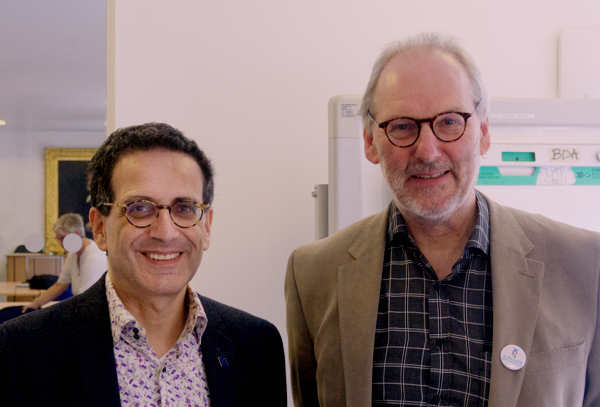
Stéphabe Goldstein and Geoff Walton
Our two ILG speakers, Stéphane Goldstein (left) and Geoff Walton (right).
Stéphane Goldstein: How CILIP redefined Information Literacy
We had two excellent speakers, Stéphane Goldstein and Geoff Walton. Stéphane led by establishing the background and explaining CILIP’s revised definition of Information Literacy, and Geoff reported a couple of practical research projects with young people.
Stéphane is an independent research consultant, with a strong interest in information and digital literacy. He acknowledged that those are contested terms, and he’d address that. With Geoff he’s been actively involved in CILIP’s Information Literacy Group (henceforth, ‘ILG’), one of 20 or so CILIP Special Interest Groups. His role in ILG is as its advocacy and outreach officer.
First he would tell us how ILG has developed its approach, and produced a new definition of Information Literacy (IL) now backed by CILIP as a whole. Secondly, he would tell us about recent political developments promoting IL and associated ‘literacies’, as important societal and public policy issues.
CILIP definition document
The CILIP definition of Information Literacy, as published in 2018.
About 15 years ago, CILIP developed its first definition of Information Literacy. This focused on knowing when and why you need information, where to find it, how to evaluate it and use it, and how to communicate it in an ethical way. At that time, the definition of IL (a term which had originated in the USA) was strongly articulated around academic skills and the work of academic librarians, even though the ideas had potential relevance to many other contexts. Information literacy at this time was defined by CILIP in terms of skill-sets, such as in searching, interpretation, and information-handling.
That older definition still has quite a lot of traction, but CILIP found it necessary to move on. For one thing, it’s now thought relevant to look at IL in other workplace environments.
In 2016, ILG began redefining IL. There was a lengthy consultative process, in several stages, and a draft definition was presented at the Librarians and Information Literacy annual conference, LILAC, in Nottingham in 2017 (see https://www.lilacconference.com/lilac-archive/lilac-2017-1). The draft was formally endorsed by CILIP at the end of 2017, and the new definition officially launched at LILAC 2018.
Stéphane had a few printed copies of the document with him, but it is readily available in PDF form on the CILIP Web site.
Defining IL
So what is different about the new definition? It is more complex than the old one, because of the need to apply the concepts to more contexts and situations. To keep it manageable, it is split into four parts. The headline definition – ‘Information literacy is the ability to think critically and make balanced judgements about any information we find and use’ – is designed to be ‘bite-sized’, and then gets fleshed out and exemplified.
The second part of the document sets things in a broader context. It talks about how IL relates to other ‘literacies’ such as ‘digital literacy’ and ‘media literacy’; and points out that IL is not just a bag of skills, but also concerns how those skills are applied. It describes the competencies, the knowledge, the confidence in applying IL in different contexts. The core of the definition is then related to five principal contexts for IL.
Conrad asked if definitions of all these derived ‘literacies’ are predicated on some foundational definition of what ‘literacy’ means, and Stéphane said — No. Indeed over the years, one of the problems that IL practitioners have had in getting the idea across is that the use of the term ‘literacy’ tends to throw up blockages to communication and comprehension. ‘Basic literacy’ of course is widely understood to mean the ability to read and to write, and perhaps to perform basic arithmetic tasks. Stéphane has heard people say that to use the ‘literacy’ word in relation to information-handling might be experienced as pejorative or counter-productive, in effect labelling some people as ‘illiterate’.
In some other languages, the concepts behind IL are labelled without reference to literacy – in French, it is ‘information mastery’ (la métrise à l’information). In Germany, they speak of Informationskompetenz (‘information competence’). In the English-speaking world, IL is the term we are stuck with for historical reasons – it’s how the concept was labelled in the USA when it emerged in 1974.
Contexts of IL application
The new IL definition refer to five sorts of lifelong situations:
Everyday life
Citizenship
Education
Workplace
Health
Everyday life: CILIP says that IL has relevance to all of us, in many situations, throughout our lives. For example, it could be about knowing how to use the Internet for day-to-day transactions, such as online banking or shopping. It’s often assumed that people know how to do these things, but Stéphane reminded us that perhaps 20–25% of people lack confidence when faced with dealing with information online. Nor is there adequate access to training in these skills, either in schools or for adults.
Citizenship: These days we are beset with information of poor or dubious quality; misinformation and disinformation affect how we step up to our political responsibilities. There are IL skills involved in finding our way through the mazes of argument and alleged evidence in such matters as Brexit, climate change and so on. Judiciously picking through evidence and assertions are vital to the future of society – democratic societies in particular.
Education: This is the context where the original IL definition was at its strongest. Now we recognise it is important not just in Higher Education, but at all stages of the education cycle. ILG is concerned that school education does not teach these competencies adequately, but haphazardly, unless you are in the minority studying for the International Baccalaureat, or doing EPQs (Extended Project Qualifications, as Geoff would later explain).
If you lack prior experience in validating information, and bump into these issues for the first time at age 18 when you go to University (in the UK, about 40% of young people) — well, that’s rather too late, Stéphane thinks. There are also contexts for IL in lifelong education.
Workplace: In work settings, a lot of information needs to be dealt with, but it’s different from academic information. A lot of workplace information is vested in knowledge that colleagues have – also associates, even competitors. Working in teams presupposes an ability to exchange information effectively. Stéphane asked, how does IL skill contribute to a person’s employability?
Health: ‘Health literacy’ is increasingly important. With the NHS under pressure, people are expected to self-diagnose; but how you can find and evaluate credible information sources?
The CILIP team focused onto these five contexts as examples to keep the list manageable, but of course there are other contexts too.
The role of information professionals
The fourth and final part of the CILIP statement looks at the role ‘information professionals’ may have in helping to promote and teach and help citizens develop an understanding of IL. (In my postscript below I note that librarians tend to have a limited and one-sided notion of just who counts as an ‘information professional’.)
There have been savage cutbacks in the public library and school library sectors; and these environments are being deprofessionalised. What guiding role can be played by remaining qualified librarians, by library assistants, and by library volunteers? How can non-qualified library workers be helped to develop their appreciation of IL, to help them play a role as advocates? A definition framed around broader concepts might help school and public librarians in this task.
Stéphane thinks this redefinition is well timed, given contemporary concerns about the role in public life of disinformation. Fundamental democratic principles, which needs a level of trust between citizens and politicians and experts, are being undermined by discourses framed around flaky information. IL is one of the tools that can be of use here, though it is not the only tool.
In Stéphane’s view, the distinctions between information, digital, media literacy and so on are not that important. With digital literacy and media literacy in particular, there is a lot of overlap these days, as more media is delivered digitally. And we should admit that the term ‘information literacy’ has little currency in public discourse: it is used chiefly by librarians.
Recent illustrative developments in the policy sphere
CILIP definition document
A Parliamentary enquiry by the Digital Culture, Media and Sport Committee, looking into ‘Disinformation and “fake news”’, reported in February 2019 after 18 months of deliberation (read more and download it from here). Facebook in particular was subjected by the Committee to a great deal of criticism.
[Conrad notes — in contrast to the lambasting that Committee handed out to the social media platforms, very little was said about the disinformation and bias in the national British press and broadcasters…]
There is a chapter about ‘digital literacy’ in the Report, which says that ‘children, young adults and adults – all users if digital media – need to be equipped in general with sufficient digital literacy to be able to understand content on the Internet, and to work out what is accurate or trustworthy, and what is not.’
The Select Committee made a recommendation that ‘digital literacy should be the fourth pillar of education, alongside reading, reading and maths’. They called on the DCMS to co-ordinate with the Department for Education in highlighting proposals to include digital literacy as part of the physical, social, health and economic curriculum (PSHE). The Government, however, rejected this recommendation, claiming they are doing it already (they are not). CILIP went to talk to DfE in Spring 2019, and were told that there would be no review of the school curriculum before the next Parliament.
The Cairncross Review was commissioned to look at the future of the UK news industry, and reported at about the same time as the other DCMS committee. Amongst its observations were that online platforms’ handling of news should be placed under regulatory supervision, and it introduced the concept of ‘public interest news’. [Download the report]
That report uses the terms ‘media literacy’ and ‘critical literacy’ and echoes the Select Committee’s recommendations in calling for these skills to be promoted. It called of the Government to develop a ‘media literacy strategy’ and to identify gaps in provision and engage with all stakeholders. That recommendation has been adopted by government. This initiative came from the world of journalism, not the world of librarianship.
In April 2019 a White Paper on ‘Online Harms’ was published to initiate a consultation which has now closed (see https://www.gov.uk/government/consultations/online-harms-white-paper). The paper set out the government’s plans for a package of measures to keep UK users safe online, especially users defined as vulnerable.
The government uses a broad definition of what it means by ‘online harms’ — child sexual exploitation and abuse, terrorist content, content illegally uploaded from prisons, online sale of drugs, cyber-bullying, [encouraging] self-harm and suicide, under-age sharing of sexual imagery, and finally disinformation and manipulation. It also talks about online abuse of public figures.
Primarily the government’s White Paper aims to strengthen the regulatory environment, but it does have a nine-page sub-chapter on ways of empowering users. That section is mostly about education, and says, ‘Media and digital literacy can equip users with the skills they need to spot dangers online, to critically appraise information, and to take steps to keep themselves and others safe online. It also has wider benefits, including for the functioning of democracy, by giving users a better understanding of online content and enabling them to distinguish between facts and opinion.’
Like the Cairncross Review, the White Paper envisages the development of a National Media Literacy Strategy – which will probably take a while to evolve. It explicitly identifies librarians as partners in the development of that strategy – so perhaps CILIP’s approaches to government have not been in vain.
Stéphane expressed satisfaction that the White Paper recognises it as a serious problem when people are unable to distinguish between facts and opinions.
Measures on Health Literacy
At the end of 2017, NHS Health Education England and other bodies launched a Health Literacy Toolkit, ‘to help health staff tackle the challenges caused by low levels of health literacy, and improve health outcomes’. As the news release stated, ‘According to the Royal College of General Practitioners, health information is too complex for more than 60% of working age adults to understand, which means that they are unable to effectively understand and use health information.’ Interestingly, the toolkit aims to improve the ability of health professionals to explain health issues effectively. It was piloted in the East Midlands.
(Unfortunately, in a classic example of public sector ‘link rot’, all Health Education England URL references to the toolkit are dead-ends after just 20 months.)
IL considered in Europe
The European Commission also commissioned a report on fake news and disinformation, which offered important proposals in relation to media and information literacy. Some of the proposals are again in the educational realm, and it says ‘Media and information literacy has become an essential competence, as it is the starting point for developing critical thinking and good personal practice for discourse online, and also consequently in the offline world.’
The recommendations included better recognition of media and information literacy as key subjects for school curricula across Europe. The report also recommended that teacher training colleges incorporate media and information literacy as part of teachers’ own training and life-long learning.
Interventions in the UK (and Ireland)
Many organisations in the UK are showing an interest in IL, and the ILG has had dealings with many of them. Within DCMS there is the clumsily-named ‘Counter Online Manipulation of Security and Online Harms Directorate’ – a rather poorly resourced section, co-ordinating government policy on disinformation.
Then there is Ofcom, the communications regulator, part of its role being ‘to chart public perceptions and understanding of media literacy in the UK.’ Their understanding of media literacy is rather broad, and relates to the media environment.
The National Literacy Trust is a charity, chiefly interested in promoting basic literacy (reading and writing), but also has a set of resources on critical literacy, fake news and disinformation. You can read more and create a login to access free teaching resources, from here.
‘Newswise’ is a pilot project developed under the auspices of The Guardian newspaper, with Google funding. It helps to develop news literacy amongst primary school children. (See June 2018 Guardian article about Newswise.)
Ireland is interesting: the >Media Literacy Ireland initiative is backed by the Broadcasting Authority of Ireland (https://www.bemediasmart.ie/about) and it has brought some 40 key players together, including the national broadcaster RTÉ, the Press Council of Ireland, Sky, Facebook and Google, and the Library Association of Ireland. Stéphane thinks that it helps that Ireland’s population is only five million; in a country with 65m, it could be much more difficult.
Another challenge which Stéphane noted is, with many organisations showing an interest in these issues, how to ensure join-up and concerted activity? Internationally, UNESCO does some work in this area but it doesn’t have a lot of influence. The EU has shown an interest, but has no statutory powers in this area; its activity has been limited to research and reports.
Geoff Walton: improving information discernment
Geoff reported on research work funded by the Information Literacy Group and the British Academy. This work is interesting both for its cross-disciplinary approach and scientific components, and its trialling of practical educational interventions. The team included Jamie Barker at Loughborough University, Matt Pointon at Northumbria University, and Martin Turner and Andy Wilkinson from Staffordshire University. Geoff himself is a senior lecturer in the Department of Information and Communication at Manchester Metropolitan University.
Geoff reminded us again of the CILIP 2018 definition of Information Literacy as ‘the ability to think critically and make balanced judgements about any information we find and use’, which ‘empowers us as citizens to develop informed views and to engage fully with society.’ Geoff and colleagues focused on the bit about making informed judgements about information that was presented to the test subjects.
He also said that rather than using the term ‘balanced’, he’d prefer to say ‘well calibrated’. There seems to be a problem with the idea of balance — note how badly the BBC has misjudged the practical consequences of fetishising ‘balance’ between opposed views, notably on the Today programme, and Question Time.
The concept of information discernment
Some people are good at making well-calibrated judgements about information, and others do it poorly. The studies considered these as gradations in information discernment. The differences affect people’s responses when exposed to mis-information – emotionally, cognitively and even physiologically.
Hy-Brasil
Many maps showed the presumed location of the (mythical) island of ‘Hy-Brasil’ west or Ireland — though they often disagreed about just where it was!
The research explored this in a case study with young people 18–21 years of age. Further research with a cohort of young people aged 16–17 also found that there are ways in which we can help the ‘low discerners’ to become ‘high discerners’, with the right kind of training. Geoff would report on both.
Dis-information and mis-information are nothing new. Geoff referred to a persistent myth of the existence of a fog-shrouded island west of Ireland known as ‘Hy-Brasil’ (possibly from Irish Uí Breasail). Belief in this inspired several expeditions, and the island was marked on maps from 1325 onwards, even as late as 1865. Geoff also referred to the contemporary nutritionist Gillian McKeith, author of ‘You Are What You Eat’, and her string of bogus qualifications (see Wikipedia: the tale of how scientist Ben Goldacre obtained one of the same diplomas for his dead cat will amuse you).
Sometimes the issue is about how information is presented. Geoff referred to a BBC News report in the 1960s about a pay dispute at Monkwearmouth Pit near Sunderland, where his dad was a miner. The BBC claimed miners were taking home £20 a week. Geoff’s dad was furious at this deception: he was taking home just £15 a week. What the BBC had done was to take an average from the top to the bottom of the pay scale.
Characteristics of high information discerners — people who tend to exhibit high levels of information discernment also display these characteristics:
they are curious about the world
they are sceptical about information presented to them by search engines
they will consult more than one information source [deliberately doing so is sometimes called ‘triangulation’, with reference to the practices of land surveying]
They recognise that it is important to check the credentials of the author or other source
if they encounter contradictory information, they tend to consider it also, rather than ignore it
they display higher levels of attention to information, as shown in the eye-tracking elements of the research
In contrast, people who exhibit low levels of information discernment are significantly less likely to be aware of these issues, and are generally inattentive to the detail of information they encounter.
It’s in the blood
Geoff’s perceptions around these issues were widened by a chance conversation with some Manchester colleagues in the field of the psychology of sport and exercise. These researchers are interested in how people deal with stress, and they operate a model of challenge and threat. This then reminded Geoff of an information behaviour model proposed by Tom Wilson in the Journal of Documentation in 1999 (‘Models in information behaviour research’), in which he identifies a role for the psychological stress/coping mechanism. Out of this encounter, an interdisciplinary twist to the research was developed.
In a stressful situation, some people regard the stressor as a challenge and respond to it adaptively, but if you experience it as a threat, your response is likely to be maladaptive and unhelpful to yourself. As Geoff put it, standing before the NetIKX audience, he felt inspired to rise to the challenge, but if his response were maladaptive his throat might tighten, he might panic and fluff his lines.
Physiologically, any positive response to stress goes along with a measurable dilation (widening) of the blood vessels, especially the arteries and major veins, increasing blood flow, including of course to the brain. But in the case of maladaptive responses, the experience of threat results in the opposite, vasoconstriction, which restricts blood flow.
The research team therefore investigated whether there was a link between their ‘information discernment’ model, and measurable physiological reactions to misinformation.
The lab space
The research team set up a laboratory space with various instruments. One side was equipped with a ‘Finometer® PRO’, a non-invasive monitoring device which puts a small pressure cuff around the test subject’s finger and uses transmitted light to examine blood flow on a continuous beat-to-beat basis, reporting on blood pressure, pulse rate etc. (See http://www.finapres.com/Products/Finometer-PRO). The other side of the lab featured an eye-tracking system, which Geoff didn’t describe in detail, but he later showed us the kind of ‘attention heat map’ display it produces.
The team got their subjects to do various tasks. One task was a word-search which was actually impossible to complete satisfactorily (this reminds me of the famous Star Trek Kobiyashi Maru no-win scenario, a test of character). Obviously, not having a solution generates some mild stress. They also told the test subjects that they were helping another student, referred to as ‘the confederate’, to win £100 (this was a fib). Some participants were additionally told that the ‘confederate’ they were thus helping was a person of extreme religious views (again, not true, but a way of winding up the stress levels).
With the test completed, the test subjects were then taken through a PANAS self-reporting mood-assessing questionnaire (Positive And Negative Affect Schedule), and then the subjects were fully and honestly debriefed.
Results: There does seem to be a relationship between the level of information discernment and how subjects reacted to stress. Those whom the team classified as exhibiting high information discernment tended to react to stress as a ‘challenge’, rather than treating it like a threat to their well-being. They exhibited more efficient blood flow, and a healthier, better-adapted heart response. Also – this came as something of a surprise to the team – high information discernment individuals responded with more positive emotions in the PANAS assessment.
The information search task
Heatmap
Two of the heat maps generated by the eye-tracking equipment, showing how much attention different participants gave to different parts of the information display. That on the left was measured from someone the team considered to exhibit the characteristics of ‘high information discerner’, the one on the right, from a ‘low information discerner’.
Another task for the test subjects was to look at a page of information, made from text and data graphics sourced from The Guardian, headed ‘Religious extremism main cause of terrorism, according to report’ (it’s a rearrangement of material from a November 2014 article).
Geoff displayed a couple of ‘heat maps’ that were generated from the eye tracking monitor system, showing the extent to which different parts of the ‘page’ received the most attention from different participants: see image. The left example belonged to a ‘high discerner’, and the other to a ‘low discerner’. Admittedly, the two examples Geoff showed us were at the extremes of those observed.
Delving deeper, Geoff said that the ‘high discerner’s’ saccadic movements (this means, the sequential leaps between eye-fixation points) were measurably more ordered; this person also extensively examined the graphical components, which were completely ignored by the low discerner.
Conrad commented that there are particular skills involved in interpreting data graphics, which could make it a complicating factor in this study. It may be that the individual whose heat-map was displayed on the right does not have those skills, and therefore ignored the data graphics. Of course, lack of that skill might correlate with ‘low information discernment capability’ generally, and it doesn’t seem that unlikely, but it’s not a foregone conclusion.
From this part of the study, the research team concluded:
People with low information discernment capabilities are more likely to experience negative physical and emotional reactions [as tested by the Finometer and the PANAS review] when looking for information. This is exacerbated if the information they are presented with is contradictory.
‘Low discerners’ are less likely to attend to detail, and are unlikely to check the sources of information, or the credentials of the writer or other person telling them the information.
Can we help develop information discernment?
If it possible to move low information discerners to become high information discerners? The good news is, the team found that they could, and they offer four rules of thumb:
In such training, you need to match a person’s context as closely as you can, such as what people are typically doing and trying to find out. In other words, ‘generic’ forms of training won’t work.
The training needs to be informal and conversational.
The training should be collaborative.
It should be practical, not theoretical.
Geoff passed around some copies of materials which they prepared for the training workshop with a group of school students aged 16–17. He noted that similar results have also been recorded with first-year university students.
In this case, the subjects were given two pieces of information about smoking. One was a company Web site, the other was about research from a university. Trainees noticed things of which they were previously oblivious, such as citations and sources, and they developed an appreciation of the need to consider whether information sources are reliable.
This part of the work, funded by the British Academy, was aimed at helping a particular school deliver their Extended Project Qualification. The EPQ is an optional qualification within the National Qualifications Framework in England and Wales, taken after A-Levels, and involves producing a dissertation of about 5,000 words or some similar artefact, plus documentation showing research and thinking processes. (It is similar to the Scottish Sixth Year Studies qualification which was available from 1968 to 2000.) The EPQ assignment is probably the first time that school students have to do something where the information has not been handed to them on a plate – they have to find it out for themselves, and it is a good introduction to what they’ll meet at university.
Teachers involved in this workshop project noted a real shift in information behaviours as a result – no longer was there a passive acceptance of information, and students started to question the credibility of sources. The only problem, said Geoff, is that they can go too far and question everything, and you have to lead them back to an understanding that there are certain facts out there!
The project conclusion is that by training low information discerners, you can help them construct their own cognitive firewalls – which is better than relying on ‘machines of loving grace’ to protect us with filters and AI algorithms. We may hope that by encouraging people to have the cognitive habits and capabilities of high information discerners, they will be less susceptible to the unsubstantiated claims which permeate the Internet, and especially social media.
Stéphane and Geoff would love to work with other groups and constituencies to help mainstream Information Literacy, and would like to hear ideas for joint events and case studies.
Discussion summaries
After a break we assembled into table groups, and each table discussed a different aspect of the issue. Lissi Corfield then called on the groups to report back to a brief plenary session, and I report some of the points below:
On trusting information sources: one participant remarked that her window-cleaner had said that he got all his knowledge of what was going on in the world from Facebook. Initially that thought might inspire horror; but on the other hand, we’ve always trusted people we know as intermediates; is this so different?
IL in the workplace: the table considering this topic agreed that the tools and methods described by Geoff (and used in schools) could also find application in the workplace. But it would be lovely not to have to teach newcomers coming in from school and university about IL – they should have learned it already!
Logic and education: Another table, from which Dion Lindsay reported, thought that Logic, currently taught in the first year of university Philosophy courses, should have a place in secondary school education, as a foundation for thought. (I commented, ‘Bring back the mediaeval curriculum!’, in which Grammar, Logic and Rhetoric were the three foundational liberal arts subjects – the trivium.)
Self-awareness: a fourth table group commented that there is value in helping people to be more aware of, and critical of, their own thought processes.
Awareness of how search engines work – for example, why Google searches result in a particular ranking order of results – should help to foster a more critical approach to this information gateway.
PostScript: my discomforts with the ‘IL’ term
Origins of the ‘information literacy’ term
The Zurkowski document
Paul Zurkowsky’s 1974 paper — where the term ‘information literacy’ was coined.
It was from Geoff that I learned that the term ‘information literacy’ was coined by Paul G. Zurkowski in 1974, in a report for the [U.S.] National Commission on Libraries and Information Science.
Indeed, Geoff was so kind as to email me a copy of that paper, as a PDF of a scanned typescript — a section of the cover page is shown right. In the USA, the term seems to have been picked up by people involved in Library and Information Studies (LIS) and in educational technology.
I personally first encountered the IL term in January 2003, at a workshop hosted by the British Computer Society’s Developing Countries Specialist Group, in the run-up to the UN World Summit on the Information Society. The WSIS secretariat had been pushing the idea of ‘Information Literacy’. John Lindsay of Kingston University chaired the meeting.
A temple-like model of ‘Seven Pillars of Information Literacy’ had been dreamed up four years earlier by the Society of College, National and University Libraries (SCONUL), and two LIS lecturers from London Metropolitan University were promoting it. A full account of that workshop is available as PDF.>
SCONUL model of IL: seven pillars
SCONUL’s ‘Seven Pillars of Information Literacy’, redrawn by Conrad Taylor.
I took an immediate dislike to the term. Everyone agrees that true literacy, the ability to read and to write, is a fundamental skill and a gateway to learning; and this smelt to me like a sly attempt to imply that librarians, with their information retrieval and analysis skills, were as valuable to society as teachers.
In September 2003 I ran a conference called Explanatory and Instructional Graphics and Visual Information Literacy. My preparatory paper ‘New kinds of literacy, and the world of visual information’ is available from this link.
Also, proper literacy requires skills in consumption (reading) and production (writing), but in my experience librarians consistently don’t say much to recognise the skills used by those making information products: writers and illustrators, graphic designers, documentary film producers, encyclopaedists and so on.
There is a term ‘visual literacy’ as featured since 1989 in the journal of the same name and the International Visual Literacy Association, but I am prepared to cut that use of the L-word more slack because IVLA and the journal are concerned about design as well as consumption.
As for the implication that Stéphane referred to, that someone having difficulty in finding and making critical judgements about information is in effect being shamed as ‘illiterate’, I confess that objection hadn’t occurred to me.
Critique the object/system, not the hapless user?
In the field of Information and Communication Design, where I have been a practitioner for 30+ years, our professional approach to failures of communication or information discovery is not to default to blaming the reader/viewer/user, but to suspect that the information artefact or system might not have been designed very well. It’s just not on to react to such problems by claiming the public is ‘information illiterate’, when the problem is your illiterate inability to communicate clearly.
Some weeks later, while at the ISKO UK conference, it also occurred to me that people who work to improve the way information sources are organised, and work on improving how they are documented and accessed, share this attitude with Information Designers. They also do not accuse people of ‘illiteracy’ – they address the lack of coherence in the information. Is there something about librarian culture that resists deconstructing and critiquing information products and systems, and leaves them inviolate on a pedestal?
Anyway, I’ll draw my small tirade to a close! I do agree that there is A Problem, and I largely agree with Stéphane and Geoff about the shape of that problem. I shall continue to place quote marks around ‘information literacy’ and contest the use of the term. I like the German alternative that Stéphane mentioned, Informationskompetenz. I think I shall refer to ‘information handling competences’ in the plural, as my Preferred Term.
— Conrad Taylor, July 2019

May 2020 Seminar: How do we thrive in a hyper-connected, complex world?
/in Events 2020, K and I sharing: networking, K and IM: professional development, Knowledge and information management, Knowledge and information sharing, Previous Events/by NetikxSummary
This meeting was a regular Knowledge Café that David Gurteen held especially for NetIKX members. We heard David set out the reasons he felt the world had changed beyond all recognition since the second world war. He listed the familiar story of the internet, transport advances, global finances and social media but also more unexpected aspects that give our world a new complexity. Then he invited us into break-out groups to share our own ideas on this fascinating topic. After a break, David focused our attention on his favoured area of expertise; the need for new leadership styles and the power of conversation. He was very clear that people did not need a title of leader to develop the power of leadership. We joined second break-outs to take our networking further. Then we shared ideas in a stimulating plenary. The meeting showed the value of the Knowledge Café approach, but also was a masterclass in using Zoom as the communication media. NetIKX will take the ideas and the methods forward for the future.
Speakers
David Gurteen is a writer, speaker, and conversational facilitator. The focus of his work is Conversational Leadership – a style of working where we appreciate the power of conversation and take a conversational approach to the way that we connect, relate, learn and work with each other. He is the creator of the Knowledge Café – a conversational process to bring a group of people together to learn from each other, build relationships and make a better sense of a rapidly changing, complex, less predictable world. He has facilitated hundreds of Knowledge Cafés and workshops in over 30 countries around the world over the past 20 years. He is also the founder of the Gurteen Knowledge Community – a global network of over 20,000 people in 160 countries. Currently, he is writing an online book on Conversational Leadership. You can join a Knowledge Café if you consult his website.
Time and Venue
2pm on 20th May 2020, The British Dental Association, 64 Wimpole Street, London W1G 8YS
Pre Event Information
The seminar was announced via the NetIKX website and explained that the seminar would be presented using the Zoom platform.
Slides
Not available.
Tweets
There were no Tweets from this meeting as we got used to our new ‘Zoom’ format.
Blog
See our blog report: Gurteen knowledge cafe
Study Suggestions
Visit David’s website: Gurteen Knowledge at www.gurteen.com
This site includes KM book reviews, news and useful quotations.
You can sign up for David’s regular newsletter from this site.
Blog for January 2020: Keeping the show on the road in a virtual world
/in Netikx/by Rob RossetTopical News!
Virtual meetings are pretty much the only meetings in town! With Corvid19 rampaging through the UK, we all need to get skilled at the art of virtual meetings as a top priority. Now is the time to show your value as a KM professional by providing skills and knowledge in the virtual meeting space. Read on for help with this now!
Introduction – the age of disruption
This is a time when we all learn to live with digital disruption. Processes and procedures that had lasted year upon year are suddenly subject to brand new ways of doing things. One of these changes has been to meetings. We no longer need to travel to go to meet someone. We have the potential to have a virtual meeting, where wonderful technology means that geography does not stop us sharing live documents and possibly even admiring each other’s outfits!
It is interesting to see this become widespread as the health risks of face to face meetings grow all around us. Using remote meetings are going to be a regular event for many of us. Let’s put in the effort to do them well.
We can go to meetings with all the information we need in the palm of our hands, via laptops or smart phones, leaving all those cumbersome files and bundles of paper behind. This opens a new world of opportunity for knowledge sharing and knowledge transfer. These changes have many advantages but, as always, it pays to think carefully about the disadvantages too, so that we can take steps to reduce them. We still need to build confidence that we all understand digital opportunities fully and are certain to get the best from them.
This article reports back from a NetIKX, (Network for Information and Knowledge Exchange), seminar where we spent a full afternoon grappling with the issues linked to Virtual Meetings.
Speaker: Paul Corney
Anyone who has sat through a meeting where many people are intently studying their mobiles, will know the frustrations that can cause. And virtual meetings are notorious for the problems that technology can introduce. Paul Corney, the President elect of CILIP, and an author and speaker of repute, took us to the heart of the issues for Knowledge Managers. If meetings are one way that we share knowledge, it is essential that we, working as we do to ensure the best possible sharing takes place, will be in the forefront of establishing good practice. As a lively and engaging speaker, Paul at once convinced his audience that he would be able to take us through the minefield of virtual meetings and help us take power over the essentials of good practice.
The potential range
We considered all the possibilities for a wide range of meetings. Paul has a wealth of experience – he had been line managed by someone on the other side of the globe, 9,000 miles away – clearly virtual meetings would be required and when it is your boss on the line, you don’t want to have any distractions messing up communication. He also highlighted examples from the recently published KM Cookbook, including the International Olympic Committee whose Knowledge Management programme began in Sidney in 2000 and where significant amounts of knowledge is now organised and transferred. This can allow learning to be disseminated to wider groups than ever possible before. It also highlights a variety of issues such as organising subgroups and breakouts.
An example
We did not just talk about virtual meetings – we invited one of our members, who could not attend because they were sick, to join us online. True to form, in one way it was wonderful. Conrad was able to talk to the crowd in the room from his sickbed. (Please don’t worry, he has recovered now). He spoke about his experience of virtual meetings, including bemoaning, in his memorable phrase: ‘survival of the loudest’. But the technology only delivered half its promise! We could only hear Conrad, as the visuals refused to work. That made the experience less rich, although as a demonstration that technology can let you down, it was very apposite. If Conrad had been invited for a long speech, this could have been a disaster, as it is much harder for an audience to concentrate when there are no visual clues to keep their attention. As it was, we only suffered from not learning what colour pyjamas Conrad wears!
Video mishaps
Paul took us through a short masterclass, aided by a stunning slide set, looking at the benefits and pitfalls; the good, the bad and the just plain awkward. One of the resources he introduced to us was a short video clip (A Conference Call in Real Life) which portrayed a virtual meeting as if it was a traditional face to face meeting. This had the impact of presenting what we know can go wrong but made hilarious when acted out. For example: the times when people were talking but the sound had gone or the strange situation of ‘Pete has joined the meeting’ intoned several times as Pete’s link drops and he has to keep getting back up and running. And of course, the ‘lurker’ who was in the meeting all the time but did not let anyone know he was there! Believe me, that is very funny when you see it! It certainly did highlight all the possible jinxes we can meet when we try virtual meetings.
Resources
As Knowledge Management advocates, we understand the importance of the media when messages are to be transmitted and it is vital that we don’t reduce our effectiveness in our ability to share when we embrace the most forward-looking technology. The video clip was just one of the valuable resources we looked at during the meeting. Since the seminar, NetIKX has collected a small set of resources that can be used to help understanding the issues, and they are available through our website.
Audience input
One great resource of a NexIKX meeting is that the attendees are all participants who contribute their own learning from experience. As a result, we could pool our ideas about the different technologies we had used and stories and anecdotes from actual meetings we had survived. One example that I loved was the dry comment about an internal team meeting with a home worker: ‘the meeting didn’t go well, but at least we all saw her sitting room!’ It brings back memories of the famous incident of the newsreader whose children toddled and crawled into view while he was broadcasting! It is a useful reminder for all video link meetings that you need to consider ensuring you have an appropriate background setting…
Technology
Paul provided us with a table outlining the pros and cons of different meeting software. It was particularly helpful to get the facts, augmented by the experience of people in the room. Of course, there are different ‘best choice’ options depending on the type of meetings you intend to support and the available resources. One well-resourced organisation uses Microsoft Teams, which will control social media use through that device, while others use Zoom, a simpler choice, or Webex, the more traditional option. (This very useful table is available on the NetIKX website). Once your software is chosen, you need to ensure that there are no problems with users having different software versions, or incompatible systems and remembering that simply because they have the software, this does not mean they know how to use it effectively!
Security
Of course, the best meetings have help and support from technology expertise; a strong reason for keeping good relations with our counterparts in the IT department! Firewalls may have to be negotiated without leading to security risks. It may be that in your eagerness to facilitate knowledge sharing you forget to consider the dangers of ‘leaking’. There are many technical issues to negotiate to get the best possible solution to your virtual meeting needs.
Etiquette
And so, we come to the non-tech questions. What differences do we have to manage with a virtual meeting compared to traditional meetings? Do you need different rules? Will there be alternative ways to enforce them? Are there timing issues, or cultural issues and how do you get feedback to learn how well things worked and where you can improve? One issue that we considered carefully was whether a good meeting chair would automatically be a good virtual meeting chair or if some different skills were needed. A solution could be to have two chairs: One to manage the meeting content and another to monitor and confirm Protocol. This could solve all your problems – or possibly lead to utter confusion and conflict!
Paul suggested an interesting resource could be a book by Erin Mayer, which includes a chapter called ‘The most productive ways to disagree across cultures’, in ‘The Culture Map’. He suggested the words: ‘that is really interesting’ which from an English person with a dry turn of phrase can have an idiomatic meaning contrary to its general meaning.
Takeaways
The meeting highlighted lots of useful ideas. We then considered these in table discussions so the participants, (not including the virtual entrant – we let him retire early,) were able to pull together the ideas they had found useful. NetIKX meetings always include a time for table discussions, so that people have a chance to embed the ideas in their own context and pick up ideas from networking with people from other workspaces. In this case, we all considered what was the most useful tip from the meeting in our small groups. We then amalgamated the ideas from all the groups into a main list and the voted for the best of all! This was fun, and perhaps a little frustrating as the results were left for me to reveal in this article. I will give our full list as they were all deemed useful. Here are the TOP TEN in reverse order of popularity.
10.Consider security – don’t overlook this when tackling the technology issues.
9. Consider if the meeting needs to have small groups, or specific break-out groups.
8, Ensure the participants understand the established etiquette.
7. Ensure participants are confident and competent with the technology before the meeting starts.
6. Consider how the role of Chair will need to adapt to the virtual format.
5. Consider if you can build on face to face meetings to supplement the virtual ones.
4. Decide if you need to have two people taking lead roles: Chair of Content and Chair of Protocol?
Are you ready? Drumroll please! Now for the top three:
3.Consider cultural issues as these may be emphasized and exacerbated by the virtual format
2. Preparation is vital: IT compatibility and time issues etc. need to be thought through.
Yes, in top place!
The recommendation that reminds us all that virtual meetings will ultimately have the same dynamic as any other meeting:
1. It is most essential to have a clear purpose and outcomes that are understood by all participants.
Conclusion
When the NetiKX meeting ended, the conversations did not. Refreshments helped the chatter flow and we continued for a very satisfactory networking session with wine and soft drinks, finger food and chat. All in all, it was a highly successful NetIKX meeting with a dazzling speaker and plenty of learning for all concerned. I hope this summary of what went on has been useful for you. If you want more here are three valuable resources:
Buy (or win) Paul Corney’s book:
Paul has a new book available to buy. It is called: The KM Cookbook : Stories and strategies for organisations exploring Knowledge Management Standard ISO30401 By Chris J. Collison , Paul J. Corney and Patricia Lee Eng
NetIKX has two copies and is running competitions on their website for them. The first was won by one of our members who works with Plan International. The next competition will be later in the Spring. Watch out for this at www.netikx.org.uk. The book is published by CILIP
Website resources linked to this meeting
Each seminar has a page on our website where we collect resources relevant to that meeting. However, this may be for members only. Look at the page for January 2020. This includes up-to-date information on Zoom, Microsoft Teams etc.
Issues Checklist
For our members, we have compiled a simple checklist, bringing together all the ideas from the meeting. It could be a useful starting point for thinking through the issues so that you have expertise in identifying how to prepare for the best possible virtual meetings.
To join NetIKX and so gain access to this material, please go to our website and use the joining form – or alternatively come to our next seminar. This will be a virtual meeting using Zoom and led by someone with considerable experience in running virtual meetings, David Gurteen. Please look at our website for details. Contact us via the website for an opportunity to attend as our guest to enjoy a chance to talk with our members, as a taster to see what NetIKX could offer you or your organisation. We look forward to you joining us then.
This article is compiled by Lissi Corfield, based on the presentation by Paul Corney and the contribution of attendees at the NetIKX seminar in January 2020.
January 2020 Seminar: Virtual working and learning: is it working for you?
/in Events 2020, K and I sharing: networking, Knowledge and information sharing, Previous Events/by Rob RossetSummary
NetIKX had a dazzling meeting with Paul Corney, President-elect of CILIP, showing his wealth of knowledge about meetings of all kinds, and specifically virtual meetings. The presentation ranged from detailed analysis of the strengths and weaknesses of technology packages – where he pulled out some surprising issues to watch out for – to the preparation and etiquette that makes humans effective when working together at a distance. That was to be expected from someone who had once been managed by a boss located on the far side of the globe! The meeting culminated in a vote among those present to find our most useful takeaways. To learn what we decided, please look at our blog! All in all, the seminar featured lots of fun and instructive anecdotes, takeaways for the workplace, and finally networking with refreshments – it turned out to be a perfect NetIKX event.
Speakers
Paul Corney is Managing Director of Knowledge et al. A long-time business consultant with broad global experience, he spent 25 years in London as Senior Manager at Saudi International Bank and as Vice President at Zurich Reinsurance before becoming the Strategy & Business Advisor to the CEO of a dotcom software organization (Sopheon PLC) and Information & Knowledge Advisor to the CEO of a leading reinsurance broker (BMS Group). As such, he was one of the first ‘knowledge managers’ in London. Outside of work, Corney is a founding trustee of PlanZheores, a London-based charitable organization whose aim is to make good use of surplus food. He regularly speaks and holds Master Classes at international events on information and knowledge management and is a member of the British Standards Institute KM Standards Committee (KMS/1).
Time and Venue
Wednesday 29th January 2020. 2pm The British Dental Association, 64 Wimpole Street, London W1G 8YS
Pre Event Information
Following Paul’s presentation, we will have a group exercise where we will sketch a typology of virtual meeting scenarios, technologies that may underpin them, and what they make either easy or difficult. We’ll also share our own experiences of virtual meeting spaces and try to find rules of thumb whereby we can make such gatherings work better. There will then be an opportunity to network over drinks and nibbles. Do come along and join us, as we haven’t yet found a technology for pouring a complimentary glass of wine for remote participants!
Slides
Not available.
Tweets
#netikx101
Blog
See our blog report: Keeping the show on the road in a virtual world
Study Suggestions
Paul Corney’s website ‘knowledge et al‘ provides information about the books he has written including the jointly authored The KM Cookbook. You can read ‘why & how we wrote it’.
You may wish to look at Erin Meyer’s website. Her work, as mentioned in Paul’s speech, focuses on how the world’s most successful leaders navigate the complexities of cultural differences in a multicultural environment.
November 2019 Seminar: Useful evidence: getting research evidence valued and used.
/in Events 2019, Harnessing the web for information and knowledge exchange, Previous Events/by NetikxSummary
At this meeting Jonathan Breckon of the Alliance for Useful Evidence explained the role of his organisation. It is a network, hosted by the UK’s innovation charity Nesta, the government’s vehicle for designing, testing and scaling new solutions to some identified problems. These organisations champion the smarter use of evidence in social policy and practice. They do this through advocacy, convening events, sharing ideas and resources, and supporting individuals and organisations through advice and training. The work is promoted through an open access network of more than 4,300 individuals from across government, universities, charities, businesses, and local authorities in the UK and internationally which we could all join for free. He then described the COM-B framework for encouraging research use, developed by researchers at UCL, and adopted by a range of foundations and government agencies in UK and overseas.
COM-B is a ‘behaviour system’ involving three essential conditions: Capability, Opportunity and Motivation and it forms the hub of a ‘behaviour change wheel’ (BCW), around which are positioned the nine intervention functions aimed at addressing deficits in one or more of these conditions; around this are placed seven categories of policy that could enable those interventions to occur. It has been used in a number of applications, mainly health related. We looked at ways to improve hearing-aid use in adult auditory rehabilitation. He also presented the factors that influence medication-taking behaviour, a tobacco control strategy, and the NICE Obesity Guidelines.
We learned that research evidence is just one factor that can influence decision-making at a policy and practice level. Various interventions have been developed to enhance and support the use of research evidence by decision-makers. Jonathan explained that in order to decide which interventions are most effective, there had been a systematic review of research into research use, leading to these new methods for characterising and designing behaviour change intervention. He provided us with some practical tips on the best mechanisms for more generally getting research evidence valued and used. This then led into small group discussions where we were given time to consider what was relevant to our own organisations and how we could make use of these insights within their own work programmes.
Speakers
Jonathan Breckon has been the Director of The Alliance for Useful Evidence since it was created at Nesta in 2012. Formerly Director of Policy and Public Affairs at the Arts and Humanities Research Council, he has had policy roles at the Royal Geographical Society, the British Academy, and Universities UK. He is a member of the Cabinet Office What Works Council and a Director of the Department for Education’s What Works for Children’s Social Care. His research and professional interests cover politics and psychology, particularly the relationship between evidence and policy-making. He is a Visiting Professor at Strathclyde University and a Visiting Senior Research Fellow at King’s College London’s Policy Institute. His research and professional interests cover politics and psychology, the relationship between evidence and policy-making, and the role of professional bodies, such as medical Royal Colleges, in applying evidence-based practice. When not at work, or being ordered around by two young children, he wastes time protecting his family’s veg garden from slugs or finding excuses to go sailing in the Solent.
Time and Venue
2pm on 21st November 2019, The British Dental Association, 64 Wimpole Street, London W1G 8YS
Slides
No slides available for this presentation
Tweets
#netikx100
Blog
There is no blog report for this seminar.
Study Suggestions
Nesta Website: https://www.nesta.org.uk/
Taxonomy Bootcamp 2019 – featuring our Book Prize Draw!
/in K and I retrieval: controlled vocabularies, Netikx/by NetikxTAXONOMY BOOTCAMP 2019!
For some years, NetIKX has been an organisational supporter of the Taxonomy Boot Camp London event (TBCL) held at Olympia in the early Autumn. That means that we help to promote TBCL, especially to our members and social media followers, and in exchange we get a stall / table-top location to use to promote ourselves, two free tickets, and 30% off for our other members should they wish to take advantage.
This year we had a successful innovation – a Book Draw. It included two books: The KM Cookbook by Chris Collison, Paul Corney and Patricia Eng Lee, from Facet Publishing. Two of the authors have spoken at NetIKX seminars, so they are ‘family’. The second book was The Knowledge Management Handbook, 2nd edition, by Nick Milton and Patrick Lambe, from Kogan Page. Note that Patrick was present at TBCL and delivered a tutorial session on the opening day. The Book Draw was popular with the authors and publishers and led to considerable interest in our stall. We look forward to the Bootcamp next year to bring more benefit to NetIKX members!
Our member, Anoushka Ferrari, was with Helen Lippell, organiser of the Taxonomy Bootcamp.
Emma Hopkins won the KM Cookbook.
Blog for July 2019: Content strategy
/in Netikx, Uncategorised/by NetikxThe speakers for the NetIKX meeting i July 2019 were Rahel Baillie and Kate Kenyon. Kate promised they would explain what Content Strategy is and what it isn’t and how it relates to the work of Knowledge Management Professionals. The two speakers came at this work from different backgrounds. Rahel deals with technical systems while Kate trained as a journalist and worked at the BBC.
Managing content is different from managing data. Content has grammar and it means something to people. Data such as a number in a field is less complex to manage. This is important to keep in mind because businesses consistently make the mistake of trying to manage content as if it were data. Content strategy is a plan for the design of content systems. A content system can be an organic, human thing. It isn’t a piece of software, although it is frequently facilitated by software. To put together a content strategy, you have to understand all the potential content you have at hand. You want to create a system that gives repeatable and reliable results. The system deals with who creates content, who checks it, who signs it off and where it is going to be delivered. The system must govern the management of content throughout its entire lifecycle. The headings Analyse, Collect, Manage and Deliver can be useful for this.
Kate pointed out that if you are the first person in your organisation to be asked to look at content strategy, you might find yourself working in all these areas, but in the long run, they should be delegated to the appropriate specialists who can follow the Content Strategy plan. In brief, the first part of content strategy is to assess business need, express it in term of business outcomes and write a business case. It is part of the job to get a decent budget for the work! When you have a clear idea of what the business wants to achieve, the next question is – where are we now? What should we look at? You will need to audit current content and who is producing it and why. Assess the roles of everyone in the content lifecycle – not just writers and editors but also who commissions, creates and manages it as well as who uploads it, and archives it. Then look at the processes that enable this. Benchmark against standards to see if the current system is ‘good enough’ for purpose. Define the scope of your audit appropriately. The audit is not a deliverable, though vital business information may emerge. It is to help you see priorities by perhaps doing Gap Analysis. Then create a requirements matrix which helps clarify what is top priority and what not.
From this produce a roadmap for change and each step of the way keep the business on side. A document signed off by a Steering Committee is valuable to ensure the priorities are acknowledged by all!
The discussion that followed considered the work in relation to staff concerns. For example people might be scared at the thought of change, or worried about their jobs. It was great to have such experienced speakers to meet concerns that were raised. The meeting ended with Kate demonstrating some of the positive outcomes that could be achieved for organisations. There is huge potential for saving money and improving public facing content.
This is taken from a report by Conrad Taylor. See the full report on Conrad Taylor’s website: Content Strategy
July 2019 Seminar: Using content strategy to meet your business goals: content strategy at work
/in Content management, Content management: strategy, Events 2019, Previous Events/by NetikxSummary
The seminar in July received very positive feedback. The two speakers were able to present their different perspectives on this practical topic with expertise and they coordinated together like the perfect double act! The audience learnt from first hand experience how to work through the four stages of Content Strategy development, and then had a chance to question the speakers so that the presentation could be directly linked to current real life examples. There was a final syndicate session that gave all present the opportunity to try their skills in a potential problem situation. Several of the audience members commented that what they had learnt from the session was immediately applicable to their own work situations and therefore would be in use by Monday morning!
Rahel Baillie and Kate Kenyon explained the role of content strategy in an organisation, and gave an in-depth view of the processes and tools used to transform existing content and knowledge into a profitable business asset. They addressed the question: what exactly is content strategy? And how is it useful to knowledge management. The two presenters had a wealth of experience in this field, gained from working with clients such as Facebook, Tesco, eBay, Cancer Research, Barclaycard, and various government agencies such as the City of Vancouver and the UK’s Department of International Trade.
In the first part of the session, Kate and Rahel looked at what content strategy is, and what it isn’t. They explored how content strategy as a discipline relates to knowledge management within an organisation. They went into detail on how efforts are focused on adding business value through content, and they explained the tools and processes content strategists use during the discovery process.
The second part of the session prided an opportunity to put these tools and processes into effect in a practical session aimed at creating a content strategy. Using a group of independent knowledge management specialists as the “client”, groups used techniques such as needs analysis, a content audit and content engineering to try and create a winning strategy and roadmap.
Speakers
Rahel Baillie has a strong track record of delivering end-to-end content systems in the context of digital strategy projects, often in environments with complex content delivery requirements: the professional who delivers the hard truths and sometimes difficult prescriptions that help organisations leverage their content as a business asset. To achieve this means analysing business problems to see where content is preventing organisations from meeting their business goals, defining content offerings, and then developing systems that integrate various types of content in to a coherent strategy to optimise its production and delivery in a way that allows it to be used to meet the goals of the organisation. See her full profile here: linkedin.com/in/rahelannebailie
Kate Kenyon is a senior content strategist with 15 years of experience solving all the gnarly problems that come with large-scale digital content management. Originally trained as a journalist at the BBC in 2005, she moved from creating content into the much harder challenge of managing it, and has been working in this area ever since. She has worked across the full spectrum of content strategy from writing to governance. Kate has a particular interest in the more technical aspects of content strategy: modelling content into scalable structures, particularly for voice assistants and multiplatform, as well as API definition. Her work has allowed her to work with a wide range of clients including Facebook, eBay, Tesco, Expedia, HSBC, Cancer Research UK, JustGiving, eHarmony and Mumsnet.
Time and Venue
2pm on 25th July 2019, The British Dental Association, 64 Wimpole Street, London W1G 8YS
Pre Event Information
What exactly is content strategy? And how is it useful to knowledge management professionals? This seminar will clarify the role of content strategy in an organisation, and give an in-depth view of the processes and tools used to transform existing content and knowledge into a profitable business asset. Presenters will bring a wealth of experience, gained from working with clients such as Facebook, Tesco, eBay, Cancer Research, Barclaycard, and various government agencies such as the City of Vancouver and the UK’s Department of International Trade. In the first part of the session, Kate and Rahel will begin with a look at what content strategy is, and what it isn’t. They will explore how content strategy as a discipline relates to knowledge management within an organisation. They will go into detail on how efforts are focused on adding business value through content, and explain the tools and processes content strategists use during the discovery process. The second part of the session will be a chance to put these tools and processes into effect in a practical session aimed at creating a content strategy. Using a group of independent knowledge management specialists as the “client”, we will use techniques such as needs analysis, a content audit and content engineering to create a winning strategy and roadmap.
Seminar Objectives:
• To understand what is meant by content strategy
• To determine how useful it is to knowledge management professionals
• To begin to understand how to develop a content strategy
Slides
No slides available for this presentation
Tweets
#netikx99
Blog
See our blog report: Content strategy
Study Suggestions
None available
Blog for May 2019 – Information Literacy
/in Netikx/by NetikxInformation Literacy
Account by Conrad Taylor of a NetIKX meeting with Stéphane Goldstein and Geoff Walton of the CILIP Information Literacy Group — 30 May 2019.
I must preface this account of the May 2019 NetIKX seminar with a confession: I really hate the term ‘information literacy’ and can hardly bear typing the phrase without quote marks around it! I shall explain at the end of this report why I think the term is wrong and has negative connotations and consequences. In conversation with our speakers, I found that they largely agree with me – but in English, the term has stuck. I promise I’ll hold off the quote marks until I get to my postscript…
Stéphabe Goldstein and Geoff Walton
Our two ILG speakers, Stéphane Goldstein (left) and Geoff Walton (right).
Stéphane Goldstein: How CILIP redefined Information Literacy
We had two excellent speakers, Stéphane Goldstein and Geoff Walton. Stéphane led by establishing the background and explaining CILIP’s revised definition of Information Literacy, and Geoff reported a couple of practical research projects with young people.
Stéphane is an independent research consultant, with a strong interest in information and digital literacy. He acknowledged that those are contested terms, and he’d address that. With Geoff he’s been actively involved in CILIP’s Information Literacy Group (henceforth, ‘ILG’), one of 20 or so CILIP Special Interest Groups. His role in ILG is as its advocacy and outreach officer.
First he would tell us how ILG has developed its approach, and produced a new definition of Information Literacy (IL) now backed by CILIP as a whole. Secondly, he would tell us about recent political developments promoting IL and associated ‘literacies’, as important societal and public policy issues.
CILIP definition document
The CILIP definition of Information Literacy, as published in 2018.
About 15 years ago, CILIP developed its first definition of Information Literacy. This focused on knowing when and why you need information, where to find it, how to evaluate it and use it, and how to communicate it in an ethical way. At that time, the definition of IL (a term which had originated in the USA) was strongly articulated around academic skills and the work of academic librarians, even though the ideas had potential relevance to many other contexts. Information literacy at this time was defined by CILIP in terms of skill-sets, such as in searching, interpretation, and information-handling.
That older definition still has quite a lot of traction, but CILIP found it necessary to move on. For one thing, it’s now thought relevant to look at IL in other workplace environments.
In 2016, ILG began redefining IL. There was a lengthy consultative process, in several stages, and a draft definition was presented at the Librarians and Information Literacy annual conference, LILAC, in Nottingham in 2017 (see https://www.lilacconference.com/lilac-archive/lilac-2017-1). The draft was formally endorsed by CILIP at the end of 2017, and the new definition officially launched at LILAC 2018.
Stéphane had a few printed copies of the document with him, but it is readily available in PDF form on the CILIP Web site.
Defining IL
So what is different about the new definition? It is more complex than the old one, because of the need to apply the concepts to more contexts and situations. To keep it manageable, it is split into four parts. The headline definition – ‘Information literacy is the ability to think critically and make balanced judgements about any information we find and use’ – is designed to be ‘bite-sized’, and then gets fleshed out and exemplified.
The second part of the document sets things in a broader context. It talks about how IL relates to other ‘literacies’ such as ‘digital literacy’ and ‘media literacy’; and points out that IL is not just a bag of skills, but also concerns how those skills are applied. It describes the competencies, the knowledge, the confidence in applying IL in different contexts. The core of the definition is then related to five principal contexts for IL.
Conrad asked if definitions of all these derived ‘literacies’ are predicated on some foundational definition of what ‘literacy’ means, and Stéphane said — No. Indeed over the years, one of the problems that IL practitioners have had in getting the idea across is that the use of the term ‘literacy’ tends to throw up blockages to communication and comprehension. ‘Basic literacy’ of course is widely understood to mean the ability to read and to write, and perhaps to perform basic arithmetic tasks. Stéphane has heard people say that to use the ‘literacy’ word in relation to information-handling might be experienced as pejorative or counter-productive, in effect labelling some people as ‘illiterate’.
In some other languages, the concepts behind IL are labelled without reference to literacy – in French, it is ‘information mastery’ (la métrise à l’information). In Germany, they speak of Informationskompetenz (‘information competence’). In the English-speaking world, IL is the term we are stuck with for historical reasons – it’s how the concept was labelled in the USA when it emerged in 1974.
Contexts of IL application
The new IL definition refer to five sorts of lifelong situations:
Everyday life
Citizenship
Education
Workplace
Health
Everyday life: CILIP says that IL has relevance to all of us, in many situations, throughout our lives. For example, it could be about knowing how to use the Internet for day-to-day transactions, such as online banking or shopping. It’s often assumed that people know how to do these things, but Stéphane reminded us that perhaps 20–25% of people lack confidence when faced with dealing with information online. Nor is there adequate access to training in these skills, either in schools or for adults.
Citizenship: These days we are beset with information of poor or dubious quality; misinformation and disinformation affect how we step up to our political responsibilities. There are IL skills involved in finding our way through the mazes of argument and alleged evidence in such matters as Brexit, climate change and so on. Judiciously picking through evidence and assertions are vital to the future of society – democratic societies in particular.
Education: This is the context where the original IL definition was at its strongest. Now we recognise it is important not just in Higher Education, but at all stages of the education cycle. ILG is concerned that school education does not teach these competencies adequately, but haphazardly, unless you are in the minority studying for the International Baccalaureat, or doing EPQs (Extended Project Qualifications, as Geoff would later explain).
If you lack prior experience in validating information, and bump into these issues for the first time at age 18 when you go to University (in the UK, about 40% of young people) — well, that’s rather too late, Stéphane thinks. There are also contexts for IL in lifelong education.
Workplace: In work settings, a lot of information needs to be dealt with, but it’s different from academic information. A lot of workplace information is vested in knowledge that colleagues have – also associates, even competitors. Working in teams presupposes an ability to exchange information effectively. Stéphane asked, how does IL skill contribute to a person’s employability?
Health: ‘Health literacy’ is increasingly important. With the NHS under pressure, people are expected to self-diagnose; but how you can find and evaluate credible information sources?
The CILIP team focused onto these five contexts as examples to keep the list manageable, but of course there are other contexts too.
The role of information professionals
The fourth and final part of the CILIP statement looks at the role ‘information professionals’ may have in helping to promote and teach and help citizens develop an understanding of IL. (In my postscript below I note that librarians tend to have a limited and one-sided notion of just who counts as an ‘information professional’.)
There have been savage cutbacks in the public library and school library sectors; and these environments are being deprofessionalised. What guiding role can be played by remaining qualified librarians, by library assistants, and by library volunteers? How can non-qualified library workers be helped to develop their appreciation of IL, to help them play a role as advocates? A definition framed around broader concepts might help school and public librarians in this task.
Stéphane thinks this redefinition is well timed, given contemporary concerns about the role in public life of disinformation. Fundamental democratic principles, which needs a level of trust between citizens and politicians and experts, are being undermined by discourses framed around flaky information. IL is one of the tools that can be of use here, though it is not the only tool.
In Stéphane’s view, the distinctions between information, digital, media literacy and so on are not that important. With digital literacy and media literacy in particular, there is a lot of overlap these days, as more media is delivered digitally. And we should admit that the term ‘information literacy’ has little currency in public discourse: it is used chiefly by librarians.
Recent illustrative developments in the policy sphere
CILIP definition document
A Parliamentary enquiry by the Digital Culture, Media and Sport Committee, looking into ‘Disinformation and “fake news”’, reported in February 2019 after 18 months of deliberation (read more and download it from here). Facebook in particular was subjected by the Committee to a great deal of criticism.
[Conrad notes — in contrast to the lambasting that Committee handed out to the social media platforms, very little was said about the disinformation and bias in the national British press and broadcasters…]
There is a chapter about ‘digital literacy’ in the Report, which says that ‘children, young adults and adults – all users if digital media – need to be equipped in general with sufficient digital literacy to be able to understand content on the Internet, and to work out what is accurate or trustworthy, and what is not.’
The Select Committee made a recommendation that ‘digital literacy should be the fourth pillar of education, alongside reading, reading and maths’. They called on the DCMS to co-ordinate with the Department for Education in highlighting proposals to include digital literacy as part of the physical, social, health and economic curriculum (PSHE). The Government, however, rejected this recommendation, claiming they are doing it already (they are not). CILIP went to talk to DfE in Spring 2019, and were told that there would be no review of the school curriculum before the next Parliament.
The Cairncross Review was commissioned to look at the future of the UK news industry, and reported at about the same time as the other DCMS committee. Amongst its observations were that online platforms’ handling of news should be placed under regulatory supervision, and it introduced the concept of ‘public interest news’. [Download the report]
That report uses the terms ‘media literacy’ and ‘critical literacy’ and echoes the Select Committee’s recommendations in calling for these skills to be promoted. It called of the Government to develop a ‘media literacy strategy’ and to identify gaps in provision and engage with all stakeholders. That recommendation has been adopted by government. This initiative came from the world of journalism, not the world of librarianship.
In April 2019 a White Paper on ‘Online Harms’ was published to initiate a consultation which has now closed (see https://www.gov.uk/government/consultations/online-harms-white-paper). The paper set out the government’s plans for a package of measures to keep UK users safe online, especially users defined as vulnerable.
The government uses a broad definition of what it means by ‘online harms’ — child sexual exploitation and abuse, terrorist content, content illegally uploaded from prisons, online sale of drugs, cyber-bullying, [encouraging] self-harm and suicide, under-age sharing of sexual imagery, and finally disinformation and manipulation. It also talks about online abuse of public figures.
Primarily the government’s White Paper aims to strengthen the regulatory environment, but it does have a nine-page sub-chapter on ways of empowering users. That section is mostly about education, and says, ‘Media and digital literacy can equip users with the skills they need to spot dangers online, to critically appraise information, and to take steps to keep themselves and others safe online. It also has wider benefits, including for the functioning of democracy, by giving users a better understanding of online content and enabling them to distinguish between facts and opinion.’
Like the Cairncross Review, the White Paper envisages the development of a National Media Literacy Strategy – which will probably take a while to evolve. It explicitly identifies librarians as partners in the development of that strategy – so perhaps CILIP’s approaches to government have not been in vain.
Stéphane expressed satisfaction that the White Paper recognises it as a serious problem when people are unable to distinguish between facts and opinions.
Measures on Health Literacy
At the end of 2017, NHS Health Education England and other bodies launched a Health Literacy Toolkit, ‘to help health staff tackle the challenges caused by low levels of health literacy, and improve health outcomes’. As the news release stated, ‘According to the Royal College of General Practitioners, health information is too complex for more than 60% of working age adults to understand, which means that they are unable to effectively understand and use health information.’ Interestingly, the toolkit aims to improve the ability of health professionals to explain health issues effectively. It was piloted in the East Midlands.
(Unfortunately, in a classic example of public sector ‘link rot’, all Health Education England URL references to the toolkit are dead-ends after just 20 months.)
IL considered in Europe
The European Commission also commissioned a report on fake news and disinformation, which offered important proposals in relation to media and information literacy. Some of the proposals are again in the educational realm, and it says ‘Media and information literacy has become an essential competence, as it is the starting point for developing critical thinking and good personal practice for discourse online, and also consequently in the offline world.’
The recommendations included better recognition of media and information literacy as key subjects for school curricula across Europe. The report also recommended that teacher training colleges incorporate media and information literacy as part of teachers’ own training and life-long learning.
Interventions in the UK (and Ireland)
Many organisations in the UK are showing an interest in IL, and the ILG has had dealings with many of them. Within DCMS there is the clumsily-named ‘Counter Online Manipulation of Security and Online Harms Directorate’ – a rather poorly resourced section, co-ordinating government policy on disinformation.
Then there is Ofcom, the communications regulator, part of its role being ‘to chart public perceptions and understanding of media literacy in the UK.’ Their understanding of media literacy is rather broad, and relates to the media environment.
The National Literacy Trust is a charity, chiefly interested in promoting basic literacy (reading and writing), but also has a set of resources on critical literacy, fake news and disinformation. You can read more and create a login to access free teaching resources, from here.
‘Newswise’ is a pilot project developed under the auspices of The Guardian newspaper, with Google funding. It helps to develop news literacy amongst primary school children. (See June 2018 Guardian article about Newswise.)
Ireland is interesting: the >Media Literacy Ireland initiative is backed by the Broadcasting Authority of Ireland (https://www.bemediasmart.ie/about) and it has brought some 40 key players together, including the national broadcaster RTÉ, the Press Council of Ireland, Sky, Facebook and Google, and the Library Association of Ireland. Stéphane thinks that it helps that Ireland’s population is only five million; in a country with 65m, it could be much more difficult.
Another challenge which Stéphane noted is, with many organisations showing an interest in these issues, how to ensure join-up and concerted activity? Internationally, UNESCO does some work in this area but it doesn’t have a lot of influence. The EU has shown an interest, but has no statutory powers in this area; its activity has been limited to research and reports.
Geoff Walton: improving information discernment
Geoff reported on research work funded by the Information Literacy Group and the British Academy. This work is interesting both for its cross-disciplinary approach and scientific components, and its trialling of practical educational interventions. The team included Jamie Barker at Loughborough University, Matt Pointon at Northumbria University, and Martin Turner and Andy Wilkinson from Staffordshire University. Geoff himself is a senior lecturer in the Department of Information and Communication at Manchester Metropolitan University.
Geoff reminded us again of the CILIP 2018 definition of Information Literacy as ‘the ability to think critically and make balanced judgements about any information we find and use’, which ‘empowers us as citizens to develop informed views and to engage fully with society.’ Geoff and colleagues focused on the bit about making informed judgements about information that was presented to the test subjects.
He also said that rather than using the term ‘balanced’, he’d prefer to say ‘well calibrated’. There seems to be a problem with the idea of balance — note how badly the BBC has misjudged the practical consequences of fetishising ‘balance’ between opposed views, notably on the Today programme, and Question Time.
The concept of information discernment
Some people are good at making well-calibrated judgements about information, and others do it poorly. The studies considered these as gradations in information discernment. The differences affect people’s responses when exposed to mis-information – emotionally, cognitively and even physiologically.
Hy-Brasil
Many maps showed the presumed location of the (mythical) island of ‘Hy-Brasil’ west or Ireland — though they often disagreed about just where it was!
The research explored this in a case study with young people 18–21 years of age. Further research with a cohort of young people aged 16–17 also found that there are ways in which we can help the ‘low discerners’ to become ‘high discerners’, with the right kind of training. Geoff would report on both.
Dis-information and mis-information are nothing new. Geoff referred to a persistent myth of the existence of a fog-shrouded island west of Ireland known as ‘Hy-Brasil’ (possibly from Irish Uí Breasail). Belief in this inspired several expeditions, and the island was marked on maps from 1325 onwards, even as late as 1865. Geoff also referred to the contemporary nutritionist Gillian McKeith, author of ‘You Are What You Eat’, and her string of bogus qualifications (see Wikipedia: the tale of how scientist Ben Goldacre obtained one of the same diplomas for his dead cat will amuse you).
Sometimes the issue is about how information is presented. Geoff referred to a BBC News report in the 1960s about a pay dispute at Monkwearmouth Pit near Sunderland, where his dad was a miner. The BBC claimed miners were taking home £20 a week. Geoff’s dad was furious at this deception: he was taking home just £15 a week. What the BBC had done was to take an average from the top to the bottom of the pay scale.
Characteristics of high information discerners — people who tend to exhibit high levels of information discernment also display these characteristics:
they are curious about the world
they are sceptical about information presented to them by search engines
they will consult more than one information source [deliberately doing so is sometimes called ‘triangulation’, with reference to the practices of land surveying]
They recognise that it is important to check the credentials of the author or other source
if they encounter contradictory information, they tend to consider it also, rather than ignore it
they display higher levels of attention to information, as shown in the eye-tracking elements of the research
In contrast, people who exhibit low levels of information discernment are significantly less likely to be aware of these issues, and are generally inattentive to the detail of information they encounter.
It’s in the blood
Geoff’s perceptions around these issues were widened by a chance conversation with some Manchester colleagues in the field of the psychology of sport and exercise. These researchers are interested in how people deal with stress, and they operate a model of challenge and threat. This then reminded Geoff of an information behaviour model proposed by Tom Wilson in the Journal of Documentation in 1999 (‘Models in information behaviour research’), in which he identifies a role for the psychological stress/coping mechanism. Out of this encounter, an interdisciplinary twist to the research was developed.
In a stressful situation, some people regard the stressor as a challenge and respond to it adaptively, but if you experience it as a threat, your response is likely to be maladaptive and unhelpful to yourself. As Geoff put it, standing before the NetIKX audience, he felt inspired to rise to the challenge, but if his response were maladaptive his throat might tighten, he might panic and fluff his lines.
Physiologically, any positive response to stress goes along with a measurable dilation (widening) of the blood vessels, especially the arteries and major veins, increasing blood flow, including of course to the brain. But in the case of maladaptive responses, the experience of threat results in the opposite, vasoconstriction, which restricts blood flow.
The research team therefore investigated whether there was a link between their ‘information discernment’ model, and measurable physiological reactions to misinformation.
The lab space
The research team set up a laboratory space with various instruments. One side was equipped with a ‘Finometer® PRO’, a non-invasive monitoring device which puts a small pressure cuff around the test subject’s finger and uses transmitted light to examine blood flow on a continuous beat-to-beat basis, reporting on blood pressure, pulse rate etc. (See http://www.finapres.com/Products/Finometer-PRO). The other side of the lab featured an eye-tracking system, which Geoff didn’t describe in detail, but he later showed us the kind of ‘attention heat map’ display it produces.
The team got their subjects to do various tasks. One task was a word-search which was actually impossible to complete satisfactorily (this reminds me of the famous Star Trek Kobiyashi Maru no-win scenario, a test of character). Obviously, not having a solution generates some mild stress. They also told the test subjects that they were helping another student, referred to as ‘the confederate’, to win £100 (this was a fib). Some participants were additionally told that the ‘confederate’ they were thus helping was a person of extreme religious views (again, not true, but a way of winding up the stress levels).
With the test completed, the test subjects were then taken through a PANAS self-reporting mood-assessing questionnaire (Positive And Negative Affect Schedule), and then the subjects were fully and honestly debriefed.
Results: There does seem to be a relationship between the level of information discernment and how subjects reacted to stress. Those whom the team classified as exhibiting high information discernment tended to react to stress as a ‘challenge’, rather than treating it like a threat to their well-being. They exhibited more efficient blood flow, and a healthier, better-adapted heart response. Also – this came as something of a surprise to the team – high information discernment individuals responded with more positive emotions in the PANAS assessment.
The information search task
Heatmap
Two of the heat maps generated by the eye-tracking equipment, showing how much attention different participants gave to different parts of the information display. That on the left was measured from someone the team considered to exhibit the characteristics of ‘high information discerner’, the one on the right, from a ‘low information discerner’.
Another task for the test subjects was to look at a page of information, made from text and data graphics sourced from The Guardian, headed ‘Religious extremism main cause of terrorism, according to report’ (it’s a rearrangement of material from a November 2014 article).
Geoff displayed a couple of ‘heat maps’ that were generated from the eye tracking monitor system, showing the extent to which different parts of the ‘page’ received the most attention from different participants: see image. The left example belonged to a ‘high discerner’, and the other to a ‘low discerner’. Admittedly, the two examples Geoff showed us were at the extremes of those observed.
Delving deeper, Geoff said that the ‘high discerner’s’ saccadic movements (this means, the sequential leaps between eye-fixation points) were measurably more ordered; this person also extensively examined the graphical components, which were completely ignored by the low discerner.
Conrad commented that there are particular skills involved in interpreting data graphics, which could make it a complicating factor in this study. It may be that the individual whose heat-map was displayed on the right does not have those skills, and therefore ignored the data graphics. Of course, lack of that skill might correlate with ‘low information discernment capability’ generally, and it doesn’t seem that unlikely, but it’s not a foregone conclusion.
From this part of the study, the research team concluded:
People with low information discernment capabilities are more likely to experience negative physical and emotional reactions [as tested by the Finometer and the PANAS review] when looking for information. This is exacerbated if the information they are presented with is contradictory.
‘Low discerners’ are less likely to attend to detail, and are unlikely to check the sources of information, or the credentials of the writer or other person telling them the information.
Can we help develop information discernment?
If it possible to move low information discerners to become high information discerners? The good news is, the team found that they could, and they offer four rules of thumb:
In such training, you need to match a person’s context as closely as you can, such as what people are typically doing and trying to find out. In other words, ‘generic’ forms of training won’t work.
The training needs to be informal and conversational.
The training should be collaborative.
It should be practical, not theoretical.
Geoff passed around some copies of materials which they prepared for the training workshop with a group of school students aged 16–17. He noted that similar results have also been recorded with first-year university students.
In this case, the subjects were given two pieces of information about smoking. One was a company Web site, the other was about research from a university. Trainees noticed things of which they were previously oblivious, such as citations and sources, and they developed an appreciation of the need to consider whether information sources are reliable.
This part of the work, funded by the British Academy, was aimed at helping a particular school deliver their Extended Project Qualification. The EPQ is an optional qualification within the National Qualifications Framework in England and Wales, taken after A-Levels, and involves producing a dissertation of about 5,000 words or some similar artefact, plus documentation showing research and thinking processes. (It is similar to the Scottish Sixth Year Studies qualification which was available from 1968 to 2000.) The EPQ assignment is probably the first time that school students have to do something where the information has not been handed to them on a plate – they have to find it out for themselves, and it is a good introduction to what they’ll meet at university.
Teachers involved in this workshop project noted a real shift in information behaviours as a result – no longer was there a passive acceptance of information, and students started to question the credibility of sources. The only problem, said Geoff, is that they can go too far and question everything, and you have to lead them back to an understanding that there are certain facts out there!
The project conclusion is that by training low information discerners, you can help them construct their own cognitive firewalls – which is better than relying on ‘machines of loving grace’ to protect us with filters and AI algorithms. We may hope that by encouraging people to have the cognitive habits and capabilities of high information discerners, they will be less susceptible to the unsubstantiated claims which permeate the Internet, and especially social media.
Stéphane and Geoff would love to work with other groups and constituencies to help mainstream Information Literacy, and would like to hear ideas for joint events and case studies.
Discussion summaries
After a break we assembled into table groups, and each table discussed a different aspect of the issue. Lissi Corfield then called on the groups to report back to a brief plenary session, and I report some of the points below:
On trusting information sources: one participant remarked that her window-cleaner had said that he got all his knowledge of what was going on in the world from Facebook. Initially that thought might inspire horror; but on the other hand, we’ve always trusted people we know as intermediates; is this so different?
IL in the workplace: the table considering this topic agreed that the tools and methods described by Geoff (and used in schools) could also find application in the workplace. But it would be lovely not to have to teach newcomers coming in from school and university about IL – they should have learned it already!
Logic and education: Another table, from which Dion Lindsay reported, thought that Logic, currently taught in the first year of university Philosophy courses, should have a place in secondary school education, as a foundation for thought. (I commented, ‘Bring back the mediaeval curriculum!’, in which Grammar, Logic and Rhetoric were the three foundational liberal arts subjects – the trivium.)
Self-awareness: a fourth table group commented that there is value in helping people to be more aware of, and critical of, their own thought processes.
Awareness of how search engines work – for example, why Google searches result in a particular ranking order of results – should help to foster a more critical approach to this information gateway.
PostScript: my discomforts with the ‘IL’ term
Origins of the ‘information literacy’ term
The Zurkowski document
Paul Zurkowsky’s 1974 paper — where the term ‘information literacy’ was coined.
It was from Geoff that I learned that the term ‘information literacy’ was coined by Paul G. Zurkowski in 1974, in a report for the [U.S.] National Commission on Libraries and Information Science.
Indeed, Geoff was so kind as to email me a copy of that paper, as a PDF of a scanned typescript — a section of the cover page is shown right. In the USA, the term seems to have been picked up by people involved in Library and Information Studies (LIS) and in educational technology.
I personally first encountered the IL term in January 2003, at a workshop hosted by the British Computer Society’s Developing Countries Specialist Group, in the run-up to the UN World Summit on the Information Society. The WSIS secretariat had been pushing the idea of ‘Information Literacy’. John Lindsay of Kingston University chaired the meeting.
A temple-like model of ‘Seven Pillars of Information Literacy’ had been dreamed up four years earlier by the Society of College, National and University Libraries (SCONUL), and two LIS lecturers from London Metropolitan University were promoting it. A full account of that workshop is available as PDF.>
SCONUL model of IL: seven pillars
SCONUL’s ‘Seven Pillars of Information Literacy’, redrawn by Conrad Taylor.
I took an immediate dislike to the term. Everyone agrees that true literacy, the ability to read and to write, is a fundamental skill and a gateway to learning; and this smelt to me like a sly attempt to imply that librarians, with their information retrieval and analysis skills, were as valuable to society as teachers.
In September 2003 I ran a conference called Explanatory and Instructional Graphics and Visual Information Literacy. My preparatory paper ‘New kinds of literacy, and the world of visual information’ is available from this link.
Also, proper literacy requires skills in consumption (reading) and production (writing), but in my experience librarians consistently don’t say much to recognise the skills used by those making information products: writers and illustrators, graphic designers, documentary film producers, encyclopaedists and so on.
There is a term ‘visual literacy’ as featured since 1989 in the journal of the same name and the International Visual Literacy Association, but I am prepared to cut that use of the L-word more slack because IVLA and the journal are concerned about design as well as consumption.
As for the implication that Stéphane referred to, that someone having difficulty in finding and making critical judgements about information is in effect being shamed as ‘illiterate’, I confess that objection hadn’t occurred to me.
Critique the object/system, not the hapless user?
In the field of Information and Communication Design, where I have been a practitioner for 30+ years, our professional approach to failures of communication or information discovery is not to default to blaming the reader/viewer/user, but to suspect that the information artefact or system might not have been designed very well. It’s just not on to react to such problems by claiming the public is ‘information illiterate’, when the problem is your illiterate inability to communicate clearly.
Some weeks later, while at the ISKO UK conference, it also occurred to me that people who work to improve the way information sources are organised, and work on improving how they are documented and accessed, share this attitude with Information Designers. They also do not accuse people of ‘illiteracy’ – they address the lack of coherence in the information. Is there something about librarian culture that resists deconstructing and critiquing information products and systems, and leaves them inviolate on a pedestal?
Anyway, I’ll draw my small tirade to a close! I do agree that there is A Problem, and I largely agree with Stéphane and Geoff about the shape of that problem. I shall continue to place quote marks around ‘information literacy’ and contest the use of the term. I like the German alternative that Stéphane mentioned, Informationskompetenz. I think I shall refer to ‘information handling competences’ in the plural, as my Preferred Term.
— Conrad Taylor, July 2019
May 2019 Seminar: Information Literacy: Current Ideas and Developments plus NetIKX AGM
/in Data, Events 2019, K and I sharing: information literacy, Knowledge and information sharing, Previous Events/by NetikxSummary
This session provided an opportunity to discuss current ideas and developments relating to information literacy (IL). Last year, CILIP completely overhauled its definition of IL. Unlike the previous version, which was heavily focused on academic skills, the 2018 definition places IL firmly in a broad societal context that no longer resides just within higher education. It states that ‘IL is the ability to think critically and make balanced judgments about any information we find and use. It empowers us as citizens to reach and express informed views and to engage fully with society’.
In the first part of the session, Stéphane Goldstein – who, along with the other presenter, Geoff Walton, contributed to the drafting of the definition – explained why it is so important for IL to be situated in different life-course contexts; how the definition addresses this; how IL has become particularly pertinent in light of concerns about misinformation, disinformation and ‘fake news’; how it relates to public policy issues and government priorities; and how it dovetails and overlaps with other literacies – digital, media, political – that all contribute to addressing these concerns.
The second part of the session consisted of a reflection, introduced by Geoff Walton, on two case studies examining how young people differ in the ways that they make judgements about information (both psychologically and physiologically) and what can be done to improve their approach. The first looked at how young people make judgements about information and the second gave an overview of a teaching and learning event that enables them to improve their abilities.
In a recent experiment with 18–24 year olds, it was found that those who are good at making well-calibrated judgements about information (we call them high information discerners) are more curious, tend to use multiple sources to verify information, are more likely to be sceptical about information on search engines such as Google, do not regard the first results page as the most trustworthy information and are cognisant of the importance of authority – for example is a web page on medical advice written by a qualified medic or not? Conversely, low information discerners are significantly less likely to be aware of these issues and are generally dismissive of the content put in front of them. These differences are statistically significant.
It was also found that:
1. When presented with mis-information and put under mild stress, higher discerning individuals viewed the situation as more of a challenge, rather than a threat to their well-being.
2. When presented with mis-information, those with higher information discernment levels experienced more favourable (i.e. adaptive and healthy), physiological outcomes. Specifically, individuals with high discernment responded to stress with a more efficient blood flow, equating to a healthier heart response.
3. When given mis-information, higher information discerning individuals responded with more positive emotions before and after the stressful task, in comparison to lower information discerning individuals.
4. High information discerners tend to show high concentration levels and low information discerners exhibit low concentration.
These results have health and well-being implications as well as raising educational and societal concerns. Happily, a number of tools have been devised to help young people improve their information discernment capabilities. Geoff shared these with participants. This was followed by a discussion of their merits and the implications of the various findings.
Speakers
Stephane Goldstein is Executive Director of InformAll (www.informall.org.uk) , a research and policy consultancy that specialises in information and digital literacy and which he founded in 2015. He is the Advocacy and Outreach Officer on CILIP’s Information Literacy Group, and a member of its Knowledge & Information Management Group. Stéphane is an established researcher and research manager, having published reports and articles on information literacy and other themes relating to the information and data environment. He has produced material for organisations in the information world including CILIP, SCONUL and Knowledge Exchange. He set up InformAll with the aim of helping to develop evidence-based awareness of the importance and relevance of information literacy, having previously worked at the Research Information Network, where he undertook and supported projects addressing not just information literacy, but also open access, open science, the role of libraries in supporting research and research data management.
Dr Geoff Walton is Senior Lecturer in the Dept of Languages, Information and Communications at Manchester Metropolitan University and described as one of the top ‘internationally eminent scholars and researchers’ in information literacy. He is Programme Leader for the MA Library & Information Management. Geoff is Chair of the Editorial Board for the Journal of Information Literacy and an Information Literacy Group (ILG) committee member. He is currently writing up the CILIP ILG funded project ‘Information discernment and psychophysiological well-being in response to misinformed stigmatization’. Geoff has also recently completed a British Academy funded project with Dr Ali Pickard and the late Professor Mark Hepworth. He was a librarian (in the voluntary, public and academic sectors) for 23 years before taking up a Senior Lecturer role at Northumbria University. In 2010, Geoff received the SLA Information Professional Europe Award sponsored by Dow Jones. Geoff’s main research interests are: information literacy, information behaviour, Technology Enhanced Learning, health literacy, data literacy and public libraries. He has published six books and many peer reviewed papers.
Time and Venue
2pm on 30th May 2019, The British Dental Association, 64 Wimpole Street, London W1G 8YS
Pre Event Information
Last year, CILIP completely overhauled its definition of IL and this meeting will be an opportunity to learn about the changes. See the CILIP press release and the report).
Part one will look at this in light of concerns about misinformation, disinformation and ‘fake news’; how it relates to public policy issues and government priorities; and how it dovetails and overlaps with other literacies – digital, media, political – that all contribute to addressing these concerns.
The second part of the session will look at two case studies that questioned young people about the ways that they make judgments about information and what can be done to improve their approach. The study raised important concerns. Happily, the session will show a number of tools to help young people improve their information discernment capabilities. There will be an opportunity to discuss their merits and what are the implications of our various findings for our workplaces and the information professional’s role.
Our AGM will take place at the end of the meeting.
Slides
No slides available for this presentation
Tweets
#netikx98
Blog
See our blog report: Information Literacy
Study Suggestions
The Information Literacy Website, brought to you by the CILIP Information Literacy Group is called: infolit.org.uk where you can find more information including the CILIP press release and the report itself.
Geoff Walton’s publications list can be found at: https://scholar.google.co.uk/citations?user=UwsIXpUAAAAJ&hl=en
Blog for March 2019 Seminar: Open Data
/in Netikx, Uncategorised/by NetikxThe speaker at the NetIKX seminar in March 2019 was David Penfold, a veteran of the world of electronic publishing who also participates in ISO committees on standards for graphics technology. He has been a lecturer at the University of the Arts London and currently teaches Information Management in a publishing context.
David’s talk looked at the two aspects of Open Data. The most important thing for us to recognise is Data as the foundation and validation of Information. He gave a series of interesting historical examples and pointed out that closer to the present day, quantum theory, relativity and much besides all developed because the data that people were measuring did not fit the predictions that earlier theoretical frameworks suggested. A principle of experimental science is that if the data from your experiments don’t fit the predictions of your theories, it is the theories which must be revisited and reformulated.
David talked about some classificatory approaches. He mentioned the idea of a triple, where you have an entity, plus a concept of property, plus a value. This three-element method of defining things is essential to the implementation of Linked Data. Unless you can stablish relationships between data elements, they remain meaningless, just bare words or numbers. A number of methods have been used to associate data elements with each other and with meaning. The Relational Database model is one. Spreadsheets are based on another model and the Standard Generalised Markup Language (and subsequently XML) was an approach to giving structure to textual materials. Finally, the Semantic Web and the Resource Description Framework have developed over the last two decades
Moving on to what it means for data to be Open. There are various misconceptions around this – it does not mean Open Access, a term used within the worlds of librarian ship and publishing to mean free-of-charge access, mainly to academic journals and books. We are also not talking about Open Archiving, which has a close relationship to the Open Access concept. Much of the effort in Open Archiving goes into developing standardised metadata so that archives can be shared. Open data is freely available. It is often from government but could be from other bodies and networks and even private companies.
We then watched a short piece of video showing Sir Nigel Shadbolt, in 2012, who was a founder of the Open Data Institute, which set up the open data portals for the UK government. He explains how government publication of open data, in the interests of transparency is not found in many countries and at national, regional and local level. The benefits include improved accountability, better public services, improvement in public participation, improved efficiency, creation of social value and innovation value to companies.
We heard about examples of Open Data, for example Network Rail publishes open data and benefits through improvements in customer satisfaction. It says that its open data generates technology related jobs around the rail sector and saves costs in information provision when their parties invest in building information apps based on that data. The data is used by commercial users too, but also the rail industry and Network Rail itself. The data can also be accessed by individuals and academia.
Ordnance Survey open data is important within the economy and in governance. David uses one application in his role as Chair of the Parish Council in his local village. The data allows them to see Historic England data for their area, and Environment Agency information showing sites of special scientific importance or areas of outstanding natural beauty.
After the tea-break, David showed three clips from a video of a presentation by Tim Berners-Lee. David then explained how the Semantic Web works. It is based on four concepts: a) metadata; b) structural relationships; d) tagging; d) the Resource Description Framework method of coding which in turn is based on XML.
The Open Data Institute has developed an ‘ethics canvas’, which we looked at to decide what we thought about it. It gives a list of fifteen issues which may be of ethical concern. We discussed this in our table groups and this was followed by a general discussion. There were plenty of examples raised from our collective experience, which made for a lively end to the seminar.
This is taken from a report by Conrad Taylor
To see the full report follow this link: Conradiator : NetIKX meeting report : Open Data